
Why Traditional Finance Teams Can’t Control Cloud Spend

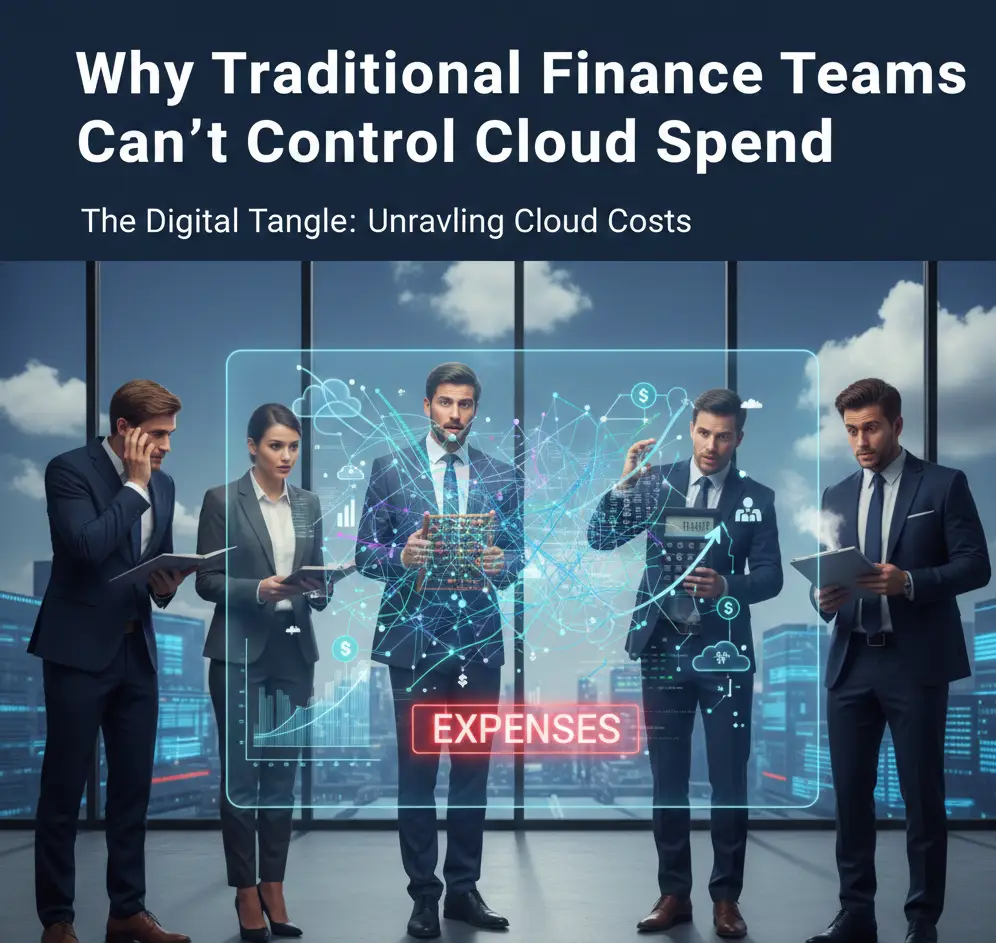
Cloud adoption has transformed the way businesses develop and scale technology. However, it has hardly changed the operational model of most finance teams. As a result, a dilemma arises in many organizations: no matter how experienced or disciplined the finance team is, traditional methods are unable to control cloud spending.
Cloud expenses keep escalating month after month; budgets get unreliable, and invoices are full of surprises. The problem is not that there is a shortage of financial expertise; instead, it is mainly due to the great disconnect between traditional finance models and cloud economics.
The Core Problem: Cloud Is Not Traditional IT Spend
Traditional finance teams are trained in managing:
- Fixed budgets
- Predictable expenses
- Annual or quarterly planning cycles
- Capital expenditure (CapEx)
Cloud, in contrast, is:
- Usage-based
- Highly dynamic
- Decentralised across teams
- Operational expenditure (OpEx)
This difference in structure is the major reason why traditional finance controls are ineffectual in cloud environments.
Reasons for the Struggle of Traditional Finance Teams with Cloud Spend
1. Cloud Spend Is in Real-Time, Finance Works Backwards
Finance teams normally assess costs after they have been incurred, monthly or quarterly.
Cloud expenses occur:
- Every second
- Every resource
- Every environment
When the finance department looks over the invoice, the expenditure has already taken place—and more often than not, the pattern has repeated.
2. Finance Without Technical Context
Cloud bills contain countless line items with:
- Compute instances
- Storage tiers
- Data transfer
- Managed services
In the absence of technical understanding, the finance team is not able to determine:
- Which resources are indispensable?
- Which are superfluous?
- Which help generate sales?
Decision-making then becomes reactive and conservative rather than being strategic.
3. No Clear Ownership of Cloud Costs
In many organisations:
- Engineering teams create resources
- DevOps teams manage infrastructure
- Finance teams see the bill
But no one controls the cost decisions fully.
Traditional finance models require one person to “own” the budget, whereas cloud spending is a shared responsibility.
4. Budgeting Models Don’t Match Cloud Reality
Finance teams depend on constant budgets and forecasts. Cloud usage is unpredictable as it is influenced by:
- Traffic spikes
- Launch of new features
- Scaling events
- Experiments and testing
In a fluctuating cloud setting, fixed budgets are unable to perform.
5. Uninformed Cost Cutting Backfires
If finance teams attempt to cutcloud spending without engineering support, they might:
- Insist on reducing critical resources
- Halt deployments
- Put off scaling
These actions result in the following:
- Decreased performance
- Frustration among engineers
- Slower growth
Cost reduction turns into an obstacle rather than a solution.
6. Cloud Bills Don’t Map to Business Value
Traditional finance teams seek:
- Cost vs department
- Cost vs budget
However, cloud demands:
- Cost per product
- Cost per customer
- Cost per feature
Finance teams become incapable of identifying ROI if the mapping is not done and can only work out the total spend.
Why More Controls Don’t Fix the Problem
Many organisations respond by adding:
- Approval processes
- Spending caps
- Manual reviews
These controls:
- Slow down teams
- Get bypassed
- Don’t scale
The problem is not the absence of control, but rather the shortage of visibility, alignment, and context.
FinOps: The Missing Operating Model
FinOps (Financial Operations) presents a solution to the existing gap between finance, engineering, and operations.
It does not substitute finance teams—it supports them to thrive in the cloud era.
How FinOps Helps Finance Teams to Control Cloud Spend
1. Real-Time Cost Visibility
FinOps doubles the number of dashboards showing:
- Live cloud spend
- Usage trends
- Cost drivers
Finance teams now have no need to wait for invoices.
2. Cost Allocation to Business Units
FinOps allocates cloud spend to:
- Teams
- Products
- Customers
This turns cloud costs into actionable business data.
3. Shared Accountability Model
Instead of finance policing spend, FinOps:
- Makes teams responsible for their usage
- Encourages cost-aware engineering decisions
- Aligns spend with outcomes
Naturally, behaviour changes.
4. Forecasting That Matches Cloud Dynamics
FinOps allows for:
- Rolling forecasts
- Usage-based budgeting
- Scenario planning
Finance regains predictability without losing flexibility.
5. Optimisation Without Slowing Growth
FinOps commits to:
- Removing waste
- Rightsizing resources
- Optimising pricing models
Thus, performance, reliability, and innovation are not compromised.
Who Feels This Pain the Most?
The problem affects:
- CFOs wrestling with inscrutable cloud bills
- Finance teams being the scapegoats for cost overruns
- Mid-size SaaS companies struggling with shrinking margin
- Startups that are burning through their runway very quickly
- Large enterprises juggling multi-cloud environments
Without FinOps, the finance team is destined to fail.
FAQs – Finance Teams & Cloud Spend Control
Can finance teams control cloud spend on their own?
Only if they have the technical knowledge and share the ownership with other teams. Otherwise, no.
Is FinOps a finance tool?
FinOps is a cross-functional operating model geared towards finance, engineering, and leadership collaboration.
Does FinOps reduce cloud costs?
Most companies achieve 20–40% ongoing cloud cost savings by implementing FinOps.
Does FinOps slow down engineering teams?
FinOps facilitates better decision-making and doesn’t restrict engineering or scaling.
Finance Doesn’t Need More Control—It Needs FinOps
Traditional finance teams are unable to limit cloud costs, not because they are undisciplined but because cloud demands a different operating model.
FinOps equips finance teams with:
- Insights replacing invoices
- Understanding replacing confusion
- Control replacing surprises
By implementing the FinOps framework, cloud expenditures will become a steady, well-planned investment—rather than a monthly shock.