
Supply Chain Security in DevOps: Securing Open-Source

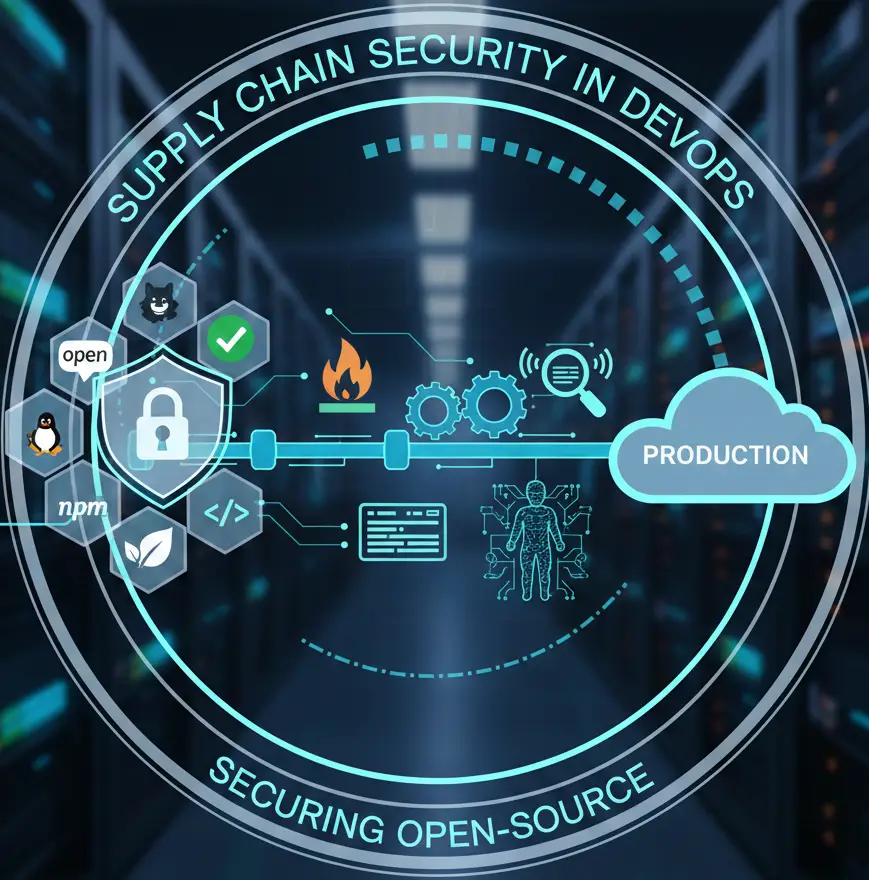
Software development teams can now release software at lightning speed. Unfortunately, speed is always accompanied by increased risk. Most modern-day applications rely heavily on open-source libraries, third-party services, and automated CI/CD pipelines. This dependency chain opens up a vast and very attractive attack surface. This is one of the reasons why DevOps supply chain security in 2026 is an issue that is getting the attention of engineering leaders, chief information security officers, and board members, to name a few.
Nowadays, in DevOps environments, attackers don’t go after the application as a whole but exploit its software supply chain.
Reasons for Attacks on Software Supply Chains
The software supply chains cover all the components involved in building and delivering an application — code repositories, dependencies, build tools, CI/CD pipelines, and deployment platforms.
The main reason attackers focus on these targets is that a single successful attack can negatively impact thousands of target systems. If an attacker manages to gain control of a dependency or a pipeline component, the malicious code can be spread around very quickly and stealthily.
With the developers’ increasing velocity, manual security checks become outdated too quickly. The resulting void renders automated supply chain security indispensable.
DevOps Supply Chain Threats
DevOps supply chain threats are not limited to the production stage only. There are also security threats at all phases of the development lifecycle.
Most of the typical threats include:
- Malicious code in open-source packages
- Vulnerable third-party libraries
- Compromised CI/CD credentials
- Unsecured build servers
- Altered artifacts and container images
These vulnerabilities can sneak from development to production without being flagged if there are no adequate controls.
Dependency Attacks and Real-World Breaches
Open-source software is the driving force of most of today’s applications. Open source helps to speed up the progress of the industry, but it also brings with it certain risks.
When talking about open source dependency security in DevOps, attackers take advantage of:
- Typosquatting packages
- Abandoned or poorly maintained libraries
- Hidden malicious code in dependencies
Some high-profile breaches have demonstrated how attackers managed to sneak malware into trusted packages, thus having the ability to reach thousands of organisations simultaneously. These events are only the tip of the iceberg in terms of the challenge that dependency security is facing.
Software Bill of Materials and Regulatory Requirements
Governments and regulators have been demanding much more transparency from software supply chains lately. As a result, heading towards SBOM compliance in DevOps is not only a good idea but also a necessity.
A Software Bill of Materials (SBOM) is a list of everything, including components, libraries, and dependencies, contained in an application. SBOMs allow organisations to:
- Spot vulnerable components swiftly
- Respond promptly to newly disclosed threats
- Comply with regulatory and customer security requirements
Two years from now, creating and updating SBOMs is going to be a fairly ordinary DevOps task instead of a compliance afterthought.
Securing Entire Build Pipelines
DevOps pipelines are the engines of DevOps and are therefore very critically important. Attackers who manage to get into a pipeline gain direct access to production systems. Securing CI/CD pipelines thus becomes the main factor when it comes to the teams’ security efforts.
Security in pipelines gets stronger when teams:
- Use separate build environments
- Keep secrets and credentials safe
- Check artefacts and images
- Limit access rights to the minimum needed
- Can keep an eye on pipeline activity in real-time
What has been discussed above represents the core of strong build pipeline security best practices.
Automated Shift-Left Security
Shift-left security means introducing security measures very early in the development lifecycle. Rather than scanning only when they ship, developers scan their code and their third party dependencies at each commit.
In open source dependency security in DevOps, some shift-left initiatives are:
- Automated scanning of dependencies
- Static code analysis
- Secret Detection
- Policy-as-Code
Automation is the key to the teams identifying vulnerabilities at an early stage, when patching them is easier and faster.
Zero Trust Security Model for Pipelines
Zero-trust security is a model that is based on the extreme distrust of any system without verification.
DevOps teams, by using zero trust to their advantage, limit the damage that a breach in one system might have and get rid of unnecessary risks.
Elements of zero-trust pipeline security are:
- User and system identity management is super strong
- Build stages have very limited and controlled access
- Artefacts are checked rigorously and frequently
- Build environments cannot be changed
Zero trust brings with it not only the prevention but also the limitation of an attacker’s movement inside pipelines.
Build Pipeline Security Best Practices for 2026
Here are the best practices that must be embraced if the goal is to be ready for the challenges of DevOps supply chain security in 2026:
- Automate dependency scanning and SBOM generation
- Enforce Policy-as-Code throughout pipelines
- Protect CI/CD credentials and secrets
- Bring zero-trust principles to pipeline access
- Continuously monitor and audit pipeline activities
These are the moves that help an organisation keep up the pace and at the same time, stay secure.
Supply Chain Security Next Stage
By the year 2026, DevOps teams won’t be isolating supply chain security as a separate initiative any longer but will instead have it fully integrated in the daily workflows.
Security matches now the speed of modern software delivery: it is proactive, automated, and scalable.
FAQs: DevOps Supply Chain Security
1. What is DevOps supply chain security?
DevOps supply chain security includes protection of code, dependencies, pipelines, and build infrastructure from unauthorised access and alterations during the entire development process.
2. Why is open-source dependency security critical?
Thanks to open-source dependencies, applications get more features and functionality. However, attackers can exploit these dependencies if vulnerabilities exist.
3. What is SBOM compliance in DevOps?
SBOM compliance is about thorough documentation and tracking of all software components used, thereby facilitating transparency and security.
4. How do teams secure CI/CD pipelines from attacks?
Teams effectively use environment isolation, credential protection, least privilege enforcement, and continuous monitoring to secure their CI/CD pipelines.
5. Will automation replace security teams?
No, it won’t. Automation is intended to assist security teams by cutting down on manual tasks and thus allowing security experts to focus more on strategic and governance issues.