
Serverless CI/CD and Cloud-Native DevOps: The Way to Faster Deployment With Less Infrastructure Overhead in 2026

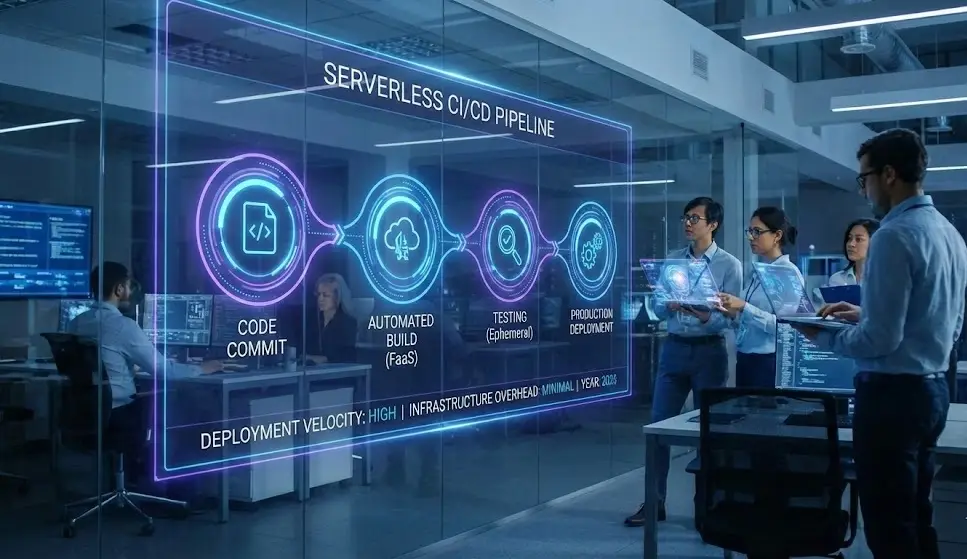
Simple and fast are the key traits of software delivery today in 2026. No more handling servers, patching build machines, or manual scaling of CI/CD infrastructure – engineering teams don’t want to do these things anymore. Code, quality, and customer value are where they want their focus to be.
Without the burden of infrastructure and with the selection of cloud-native deployment models, the teams enjoy faster deployments, easy scalability, and lower operational costs.
Serverless CI/CD Meaning
Serverless CI/CD means continuous integration and delivery pipelines that don’t require the management of servers for building and deployment.
Instead of having a team of build agents or runners, serverless CI/CD makes use of execution environments managed by the cloud, which can scale automatically.
Some features of a serverless CI/CD are:
- Building pipelines only at the trigger of an event
- Automatically scaling of the infrastructure, without any human intervention
- No server maintenance required
The whole idea fits naturally with the principles of cloud-native DevOps.
Why Old-fashioned CI/CD Pipes May Let You Down
Old-style CI/CD pipelines work with:
- Build servers that have to be on all the time
- Scaling is done by hand
- Costs of unused capacity
- Need for ongoing maintenance
These kinds of pipelines are on a collision course with the growing business: they get too costly and difficult to handle. Besides that, they become a bottleneck when there is a development spurt.
Meanwhile, serverless pipelines react instantly, get rid of idle resources, and take the burden of infrastructure management off the shoulders of DevOps teams.
Cloud-Native DevOps: Making Scale Easy
Cloud-native DevOps means coming up with, building, and constantly delivering applications that can really shine only when hosted on the cloud.
- The microservices architecture
- Containers and orchestration
- Immutable infrastructure
- Declarative configuration
- Automated scaling
Serverless CI/CD serves as the delivery engine that powers such cloud-native systems.
2026 The Reason Serverless CI/CD Has Become a Trend
There are a number of reasons why we can see that organisations are adopting serverless CI/CD, which explains the trend towards serverless CI/CD in 2026:
1. Deployments on The Fly
Serverless pipelines take no time spin up, and they can run parallel jobs, which leads to reduced build and deployment times.
2. Infrastructure Overhead Drops
Teams stop worrying about build servers, operating systems, or scaling policies.
3. Cost Efficiency
Payment is tied only to pipeline run time. No more idle infrastructure!
4. Reliability by Default
Cloud providers take care of availability, retries, and fault tolerance.
It’s only natural that organisations in 2026 would consider serverless pipelines as their standard toolkit for modern DevOps.
Real-Life Example of How Serverless Pipelines Function
The scenario presented below is an example of a typical serverless CI/CD:
- The developer pushes the latest changes to the repository
- Pusher automatically triggers the pipeline
- Builds and tests jobs via serverless functions
- Security and compliance checks happen automatically
- The app is deployed to a cloud-native environment
That’s it! On-demand, and shuts down after completion.
Cloud-Native Launch Patterns in 2026
Serverless CI/CD supports major trends in cloud-native deployment:
Continuous Delivery
Teams can put out new features multiple times per day.
Immutable Deployments
Every deployment generates a new version instead of changing old ones.
Blue-Green and Canary Releases
They use progressive rollouts to minimise risk.
GitOps-Driven Workflows
Git serves as a single source of deployment truth.
These trends are the key to innovation at a rapid pace without losing out on reliability.
Serverless CI/CD Security and Compliance
Even for serverless environments, security is, and will continue to be, the number one concern.
Modern serverless pipelines are equipped with:
- Largely automated security checks
- The use of secrets management
- Policy enforcement through code
- Access controls based on identity
As the infrastructure runs on cloud providers, the attack surface of the team is radically reduced.
With security-first DevOps, serverless pipelines are getting hand-in-hand in 2026.
Serverless CI/CD and Cloud-Native DevOps – What Do They Offer To Business?
Immediate gains can be expected by those who are quick to embrace serverless CI/CD:
- Released at a much faster rate than before
- Cut down the operational costs
- Increase developer productivity
- Enhanced system reliability
Engineers stop spending an enormous amount of their time on pipeline maintenance and better use their time to deliver value.
Serverless DevOps Next Chapter
- AI-assisted pipelines
- Predictive scaling and deployment decisions
- Closer integration with platform engineering
- Automated releases (unattended)
No longer an experiment, serverless is ready for production and trusted by enterprises.
Closing Remarks
Serverless CI/CD and Cloud-Native DevOps change the way modern teams build and deliver software. The elimination of infrastructure overhead results in a quicker rollout, effortless scaling, and lower costs.
In a speed and dependability-driven world, serverless pipelines have a definite edge.
Is your CI/CD infrastructure still cumbersome and slow? The right year to convert to a serverless approach is 2026.
Questions: Serverless CI/CD and Cloud-Native DevOps
1. Does serverless CI/CD work well with large organisations?
Of course. Multiple large organisations rely on serverless pipelines to scale their global operation minus the hassle of infrastructure management.
2. Does serverless CI/CD reduces expenses?
Yup. The only resource you pay for is your execution time, thus eliminating the idle resources cost.
3. Can serverless pipelines support complex workflows?
Definitely. Serverless pipelines are capable of supporting testing, security checks, and multi-stage deployments.
4. Is serverless CI/CD secure?
Yes. Cloud providers come with strong built-in security controls; however, teams can always implement policy-as-code and automated scanning.
5. How is serverless CI/CD different from container-based CI/CD?
In serverless, one completely removes the software and hardware side of self-management, but with container-based CI/CD, you still must manage the runners or clusters.