
RevOps in 2026: Why High-Growth Companies Are Giving Up Sales Ops for Revenue Operations

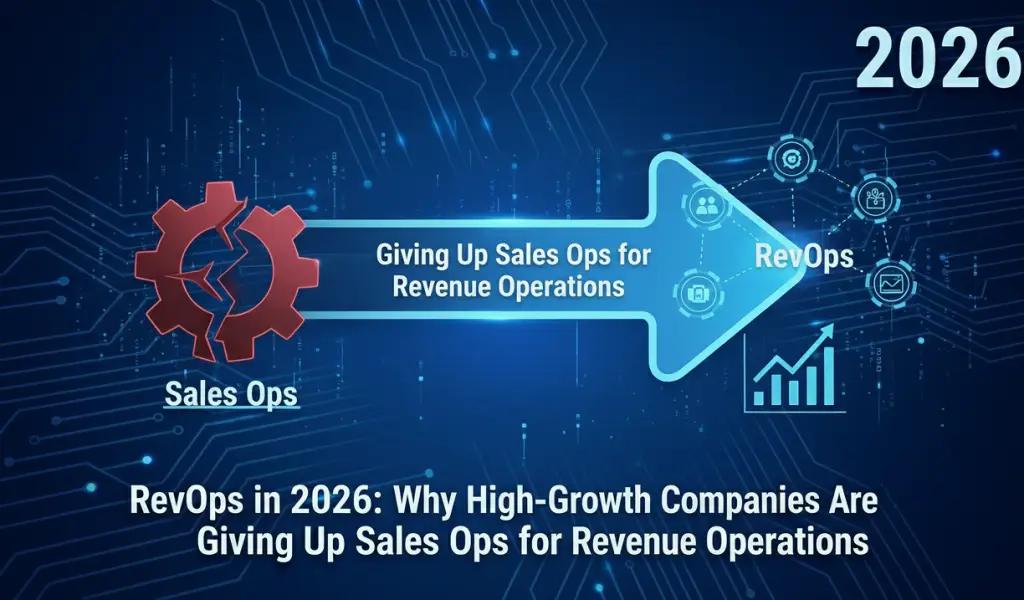
In 2026, high-growth companies no longer wonder if they should have Revenue Operations. They only ponder how soon they can have it.
For quite a long time, Sales Operations has been a kind of help function that takes care of CRM data, forecasting numbers, and preparing reports for the top management. That method is not working anymore. Customers’ buying behaviour has changed, sales cycles have gotten complicated, and now sales, marketing and customer success together determine the revenue.
This transition is the reason why RevOps in 2026 is no longer a “nice to have” element but the main revenue engine.
The Core Problem With Traditional Sales Ops
Traditional Sales Operations is almost solely focused on sales efficiency. It tries to keep track of sales funnel, quota attainment, and deal velocity. Although it was sufficient in simple markets, it fails nowadays.
Today’s revenue teams have a hard time with:
- Different marketing and sales data
- Faulty forecasting
- Insufficient customer journey visibility
- Loss of revenue at the stage of dividing the customer base between the teams
- Growth without generating profit
Sales Ops only focus on sales issues, whereas RevOps pitches in to resolve the entire revenue dilemmas.
This is the key line that separates the RevOps vs Sales Ops debate, and at the same time, it justifies why companies are changing their preferences.
What Is RevOps in 2026?
Revenue Operations (RevOps) is a single business model that combines marketing, sales, and customer success in one data-driven revenue strategy.
Rather than making each department more efficient, RevOps makes the whole revenue cycle from the first touch to expansion and renewal more efficient.
In 2026, top companies refer to RevOps as:
- A strategic revenue function
- A core data and process layer
- A cross-team decision engine
This development has rendered the Revenue Operations strategy a must for achieving predictable and scalable growth.
RevOps vs Sales Ops: The Real Difference
Here is how high-growth companies experience the difference between the two practices:
Sales Ops
- Help sales teams
- Focuses on pipeline and forecasting
- Mostly goes along with events that have happened
- Works on parts of the process only
RevOps
- Brings together marketing, sales, and customer success
- The entire revenue funnel is under its purview
- With the help of shared data, it can forecast the future and react accordingly
- Revenue is optimised from start to finish
Sales Ops tries to boost the results of isolated teams while RevOps break down those silos entirely.
This is why RevOps advantages extend to more than just better reporting or more efficient tooling.
Why RevOps in 2026 Is a Growth Necessity
Three main factors make RevOps necessary for SaaS and modern businesses:
1. Buyers Control the Journey
Buyers nowadays are carefully researching even before engaging with a sales representative. RevOps consolidates marketing and product insights along with sales data, thus allowing the sales teams to precisely target the right buyers.
2. Growth Without Profitability Is Dead
Investors clearly prefer companies which show growth through efficient use of resources. RevOps facilities such as alignment by giving access to cost and revenue data, and it also provides analytical tools to identify the CAC impact, LTV, expansion revenue, and margin.
3. AI and Automation Demand Clean Revenue Systems
The quality of data is the key to successful AI-powered forecasting and automation. Revenue Operations governance and organisational structure facilitate the use of AI to be more than just an experiment.
The Modern RevOps Framework Explained
A great 2026 RevOps framework consists of the following five fundamental pillars:
1. Unified Revenue Data
Building the single source of truth against all platforms, such as CRM, marketing, billing and customer success, plays a major role in RevOps.
2. Funnel Ownership
RevOps handles the entire revenue funnel, not just sales stages, to eliminate leaks across teams.
3. Process Standardisation
RevOps implements a scalable growth model for processes that can be adapted or extensively used, depending on the situation, e.g., lead qualification and renewals.
4. Revenue Analytics & Forecasting
RevOps utilises a combination of behaviour signals, predictive insights, and historical data to take forecasting accuracy to the next level.
5. Automation & Enablement
Automation is one of the tools from the RevOps arsenal that is used for lessening the manually executed tasks, thus quickening the work cycle and ultimately increasing the team’s efficiency.
Such an approach to revenue operations makes it a system rather than a gamble.
Why RevOps Works Especially Well for SaaS
Revenue Operations have been indispensable for the SaaS companies because the revenue sources of SaaS are retention, expansion and the lifetime value of customers rather than the number of new customers acquired.
RevOps can assist SaaS in the following aspects:
- Decrease the number of churns by handing over the customers properly
- Perfect the timing of upselling and cross-selling
- Integrate product usage data and revenue strategy
- Establish steady recurring revenue
Sales Ops by itself won’t be able to deal with such complexity. RevOps is made for it.
The Tangible Benefits of RevOps
The companies that choose to invest in RevOps in 2026 regularly encounter:
- Quicker deal closing
- More accurate forecasting
- Enhanced team collaboration
- Better use of revenue
- Superior customer experience
- Improved bottom line
RevOps benefits grow over time and make revenue expansion more long-term and less turbulent.
Final Thoughts: RevOps Is the Operating System for Growth
RevOps isn’t just another trend. It is the modern revenue operating system.
As the industry becomes more competitive and margins tighten, the companies relying heavily on Sales Ops will keep on facing the problem of not having enough information and being inefficient. Those who choose to implement a robust Revenue Operations strategy will not only be able to grow faster but they will be able to do so in a smart and profitable way.
When it comes to RevOps in 2026, the question is no longer why you would want to make the transition—It’s just how fast can you do it right.
Frequently Asked Questions (FAQs)
1. What is the most notable distinction between RevOps and Sales Ops?
Sales Ops is limited to the sales department, but RevOps is the sales, marketing, and customer success departments’ coordination under a single revenue strategy. However, RevOps entails the complete revenue lifecycle, not merely the sales journey.
2. What makes RevOps vital in 2026?
The principal reason for the necessity of RevOps in 2026 is that companies need predictable and profitable growth. The changing buyer behaviour, complicated sales cycles, and the emergence of AI-driven analytics indicate the necessity of a unified revenue operations model that Sales Ops alone cannot provide.
3. Can RevOps be implemented only in large enterprises or SaaS companies?
Not necessarily. Although RevOps for SaaS has been extensively marketed, the truth is that startups, mid-sized companies, and enterprises can all benefit from RevOps. In fact, any organisation with more than one department interacting with the customer’s revenue can benefit from improved alignment and efficiency through RevOps.
4. What are the major advantages of introducing a RevOps model?
The principal advantages of RevOps involve accurate forecasting, shortening of the lead time, minimisation of revenue leakage, customer experience improvement, and enhanced teamwork among sales, marketing, and customer success teams.
5. What is the typical duration to roll out a Revenue Operations program?
The time it takes to roll out a program varies; however, most organisations notice changes within 60–90 days. Starting a RevOps model in phases, beginning with the data alignment and funnel ownership, allows quicker and more sustainable outcomes.