
RevOps Automation in 2026: How Teams Use n8n to Connect CRM, Sales, and Finance

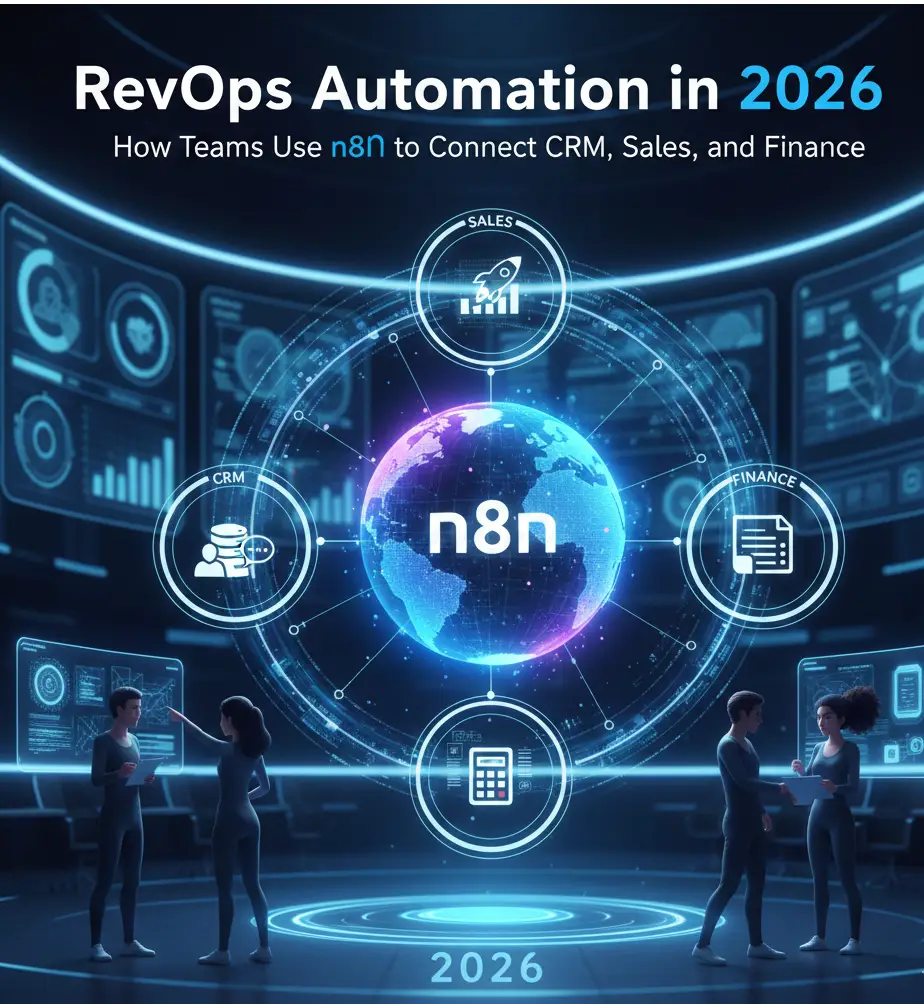
In 2026, revenue teams no longer have a hard time coming up with a strategy. What they have a hard time with is fragmentation.
Customer data is stored in CRM systems. Sales activity is scattered across various tools. Finance is keeping track of invoices, revenue, and renewals without any coordination. When these systems are not compatible, RevOps teams lose their visibility, accuracy, and speed.
This issue explains why RevOps automation has become the #1 priority—and why more and more teams rely on n8n RevOps workflows to combine CRM, sales, and finance into one smart revenue system.
What Makes RevOps Automation Even More Important
Revenue operations formerly depended on manual updates, spreadsheets, and custom scripts. Those methods can no longer be used effectively.
By 2026, revenue teams will be handling:
- Complex buying journeys
- Multiple revenue streams
- Usage-based pricing models
- Longer customer lifecycles
Without the help of revenue operations automation, teams just keep on wasting their time reconciling data instead of focusing on growth.
Automation is a tool that enables RevOps to make a shift from relying on manual coordination to letting the system take care of the execution.
n8n as a Modern RevOps Player
n8n is more than just another integration tool. It serves as a workflow automation engine that connects revenue systems without requiring heavy development.
Here are some reasons why teams choose n8n:
- It facilitates no-code and low-code automation
- It connects hundreds of tools via APIs
- It can manage complex, conditional workflows
- It is scalable as revenue operations grow
The above-mentioned flexibility is what positions n8n as an ideal wizard for No-code RevOps teams who require speed and do not want to give up control.
Step-by-Step: How Teams Use n8n to Harmonize CRM, Sales, and Finance
1. CRM Automation RevOps Teams Rely On
CRM systems are the pillar of RevOps; however, data accuracy is a precondition for that.
The teams use CRM automation RevOps workflows within n8n to:
- Automatically sync leads from marketing tools into CRM
- Get contacts enriched with firmographic and intent data
- Auto-assign leads based on territory, deal size, or product interest
- Reflect pipeline stage changes based on buyer actions
Such automation not only does away with manual CRM updating and increases the accuracy of the pipelin,e but it also results in higher productivity.
2. Sales Automation Workflows That Speed Up Deals
Sales teams lose deals primarily due to such reasons as a delayed follow-up or uncaught signals.
Thanks to sales automation workflows, n8n can now:
- Automatically assign follow-up tasks when deal activity is low
- Send real-time alerts for high-intent actions
- Create deals automatically from inbound requests
- Set up handoff workflows between SDRs and AEs
RevOps teams make these workflows to guarantee that every signal generates the appropriate response.
3. Finance Integration for Revenue Accuracy
Finance integration is one of the least recognised aspects of RevOps automation.
The teams use n8n to make these connections:
- CRM → invoicing systems
- Deal stages → billing triggers
- Subscription changes → revenue recognition updates
- Payment status → customer success alerts
Thanks to the above workflows, the finance data is a true reflection of the real-time revenue activity; thus, forecasting gets improved, and reporting gaps are reduced.
Revenue Operations Automation Across the Full Funnel
What makes revenue operations automation so powerful is that it can be used to manage an entire lifecycle and not only sales.
With n8n, RevOps teams automate:
- Lead qualification and routing
- Deal progression and forecasting updates
- Invoice creation and payment tracking
- Renewal and expansion notifications
- Churn risk alerts tied to billing or usage
The teams don’t wait for the situation to get out of hand before taking action by relying on data-driven decision-making every step of the way.
Why n8n Matches RevOps Tools
The RevOps tools 2026 market centres on flexibility and interoperability. Teams no longer accept rigid, all-in-one platforms that lock them into fixed workflows. Instead, they choose tools that adapt to their systems and scale with their revenue operations.
n8n fits modern RevOps perfectly because it:
- Works with existing tools instead of replacing them
- Enables rapid workflow experimentation
- Accommodates complex logic beyond simple triggers
- Allows RevOps teams to retain control of automation
These points illustrate an approach that is in harmony with today’s revenue teams.
No-Code RevOps: What Speed Without Compromise Looks Like
One of the biggest changes in 2026 is seen in the rise of No-code RevOps.
Rather than being at the mercy of engineers, RevOps leaders can make and change the workflow themselves. n8n enables this kind of transition with its visual workflow design capability plus custom logic support when required.
Here are the benefits:
- Faster implementation
- Lower operational overhead
- Better alignment with business needs
Automation then becomes a competitive edge rather than a bottleneck.
The Real Benefits of RevOps Automation
Those who have put resources into RevOps automation discover that it:
- Leads to cleaner CRM data
- Shortens deal cycles
- Reduces revenue leakages
- Improves alignment between teams
- Results in more accurate forecasting
However, the biggest benefit is that it allows RevOps professionals to spend their time on strategy rather than system maintenance.
Final Thoughts: Automation Is the Backbone of RevOps in 2026
In 2026, RevOps teams do not win by adding more tools. They win by intelligently connecting the right tools.
By resorting to n8n RevOps workflows to integrate CRM, sales, and finance, the scattering of systems is transformed into one single revenue engine. This makes revenue operations automation not only scalable but also resilient and ready for the future.
Revenue leaders, the message is quite simple: Automation is no longer just about efficiency; it is about control, clarity, and confidence in growth.
Frequently Asked Questions (FAQs)
1. What role do RevOps tools play in 2026?
RevOps tools in 2026 are central to teams linking sales, marketing, and finance data into a unified revenue system. Such tools give better visibility, help automate various workflow steps, and pave the way for quicker and more precise revenue decisions.
2. Why do modern RevOps teams prefer flexible tools over all-in-one platforms?
Modern RevOps teams lean towards flexible tools because they can be smoothly integrated with the existing systems, can be re-purposed if processes change, and avoid locking in a single vendor. Flexible RevOps tools give teams the freedom to scale without having to write their workflows from scratch.
3. How does n8n support revenue operations automation?
n8n enables revenue operations automation by linking CRM, sales, and finance tools via custom workflows. It automates data syncs, deal updates, billing triggers, and alerts, thereby allowing the RevOps team to lower the amount of manual tasks.
4. Can RevOps teams use n8n without engineering support?
Definitely. Creators of automation workflows in the RevOps teams use n8n as a no-code or low-code platforms and build and manage the workflows with little or no help from engineering. Thus, implementation is quicker and processes are more aligned with the revenue process.
5. Which RevOps tools matter most for growth in 2026?
RevOps tools that emphasise automation, interoperability, and data intelligence will be the most important in 2026. Teams want to have tools that facilitate CRM and sales automation workflows as well as provide real-time revenue insights without unnecessarily strict limitations.