
Platform Engineering: From Disparate Tools to a Unified Engineering Platform

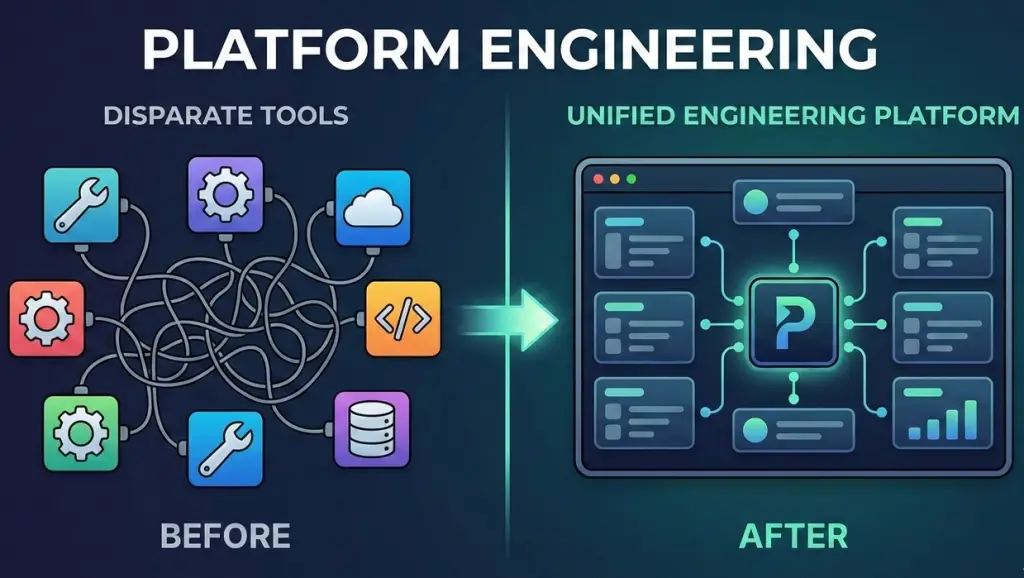
Software teams nowadays run into the same old problem: there are so many tools, but you have no idea what to do. Initially, teams would simply grab CI/CD tools, cloud services, monitoring dashboards, security scanners, and scripts. Naturally, this method of working leads to complications, team slowdown, and an increase in operational risk.
Faced with this dilemma, high-performing companies in 2026 will be implementing platform engineering.
Rather than overseeing various scattered tools, the company builds an internal developer platform (IDP) that basically accommodates the whole engineering team. Such platforms help simplify code development, achieve higher reliability, and scale in an efficient manner.
What Is Platform Engineering?
Platform Engineering means the building and maintenance of the internal platforms that give the developers reusable tools, services, and workflows.
Instead of every team building its own infrastructure and pipelines, a central platform team creates shared capabilities such as:
- CI/CD pipelines
- Infrastructure templates
- Cloud environments
- Security and compliance controls
- Monitoring and observability tools
Developers interface with these platforms through self-service workflows, without worrying about the underlying complexity.
Why Scattered Tooling No Longer Works
As companies grow, the bad habit of scattered tooling can cause a lot of problems, such as:
- Different deployment methods
- Security loopholes around teams
- The same infrastructure errors
- Slow onboarding for new developers
- High cognitive load on engineers
More and more, teams are spending a great deal of time on managing tools rather than delivering real value.
Platform Engineering fixes this by standardising workflows while still allowing flexibility where it matters.
Reasons Why Platform Engineering Has Become The Backbone Of Companies In 2026
Platform Engineering didn’t just appear out of nowhere; it’s the result of a bunch of industry trends:
1. Cloud-Native Complexity
The adoption of microservices, Kubernetes, and multi-cloud deployments has caused a significant increase in the operational overhead.
Platform Engineering ‘packaging’ the problem by providing simple user interfaces while the complex functions run in the background.
2. Developer Productivity Focus
Nowadays, companies measure their success by the developer experience (DevEx). Platform Engineering reduces friction and helps teams move faster.
3. Security and Compliance Demands
With embedded security and policy enforcement, the risk is greatly reduced without hindering the pace of development.
4. DevOps at Scale
As teams expand, traditional DevOps methods are no longer efficient.
Platform Engineering enables DevOps at a very large scale.
Internal Developer Platforms (IDPs): The Heart of Platform Engineering
An internal developer platform is like a product for developers.
It gives:
- Main routes for development
- Certified infrastructure patterns
- Built-in CI/CD pipelines
- Cloud access with security
- Integrated monitoring and logging
Developers focus on writing code, while the platform handles operations behind the scenes.
In 2026, IDPs are no longer custom side projects—they are strategic business assets.
Platform Engineering versus Traditional DevOps
DevOps is all about developers and operations working together. Platform Engineering takes the idea further.
DevOps asks:
“How do teams work together?”
Platform Engineering asks:
“How do we enable hundreds of teams to work efficiently?”
Platform teams do things that DevOps teams could only dream of:
- The DevOps way is productized by platform teams
- Duplication across teams is minimised
- Consistency is created without bottlenecks
DevOps becomes the foundation. Platform Engineering becomes the multiplier.
What Are The Key Components Of A Modern Engineering Platform?
Every successful platform has the following components:
Self-Service Infrastructure
Developers can provision their environments securely and without waiting for manual approvals.
Standardised CI/CD Pipelines
The teams are not only capable of utilizing proven pipelines but also these pipelines are designed in a way that teams automatically follow best practices.
Security by Design
Proper identity management, secrets handling, and compliance checks implementation are some examples of security layers that have been integrated.
Observability and Monitoring
A platform is capable of delivering centralised visibility in terms of services and environments.
Clear Documentation and UX
One great piece of advice for building a platform is that it should be intuitive rather than restrictive.
Business Benefits of Platform Engineering
As a place observer of an organisation implementing Platform Engineering, he or she will be able to witness the following achievements as a reality:
- Shorter time to market cycle
- Increased developers’ happiness
- Lower number of operational incidents
- Improved security measures
- Having no difficulty in the process of scaling up teams
However, the most significant change in such cases is that engineering teams will spend their time mainly on feature building and not on infrastructure fighting.
Typical issues (and the ways out)
Problem: Overengineering of the platform
Solution: Launch a small-scale platform and develop it further guided by users’ feedback
Problem: Platform is becoming a bottleneck
Solution: Decide that the platform is a product and give it a clear owner
Problem: Low adoption
Solution: Concentrate on developer experience and legitimate pain points
Platform Engineering will only succeed when developers are given power through it not controlled by it.
Platform Engineering: What Lies in Store?
Looking ahead to 2026 and the years that follow, Platform Engineering with the following features:
- AI-assisted platform operations
- Integrating GitOps more deeply
- Automating governance and policy-as-code
- Paying more attention to developer experience metrics
One can’t say for sure who among the coming-of-age companies will be the winner. Nevertheless, the most successful ones are known to have their platforms as long-term investments, not as a quick fix.
Summary
Platform Engineering is a radical transformation of the manner in which companies produce and scale software.
By shifting away from the isolated tools and moving towards a unifying platform, firms get increased speed, stability, and confidence.
The winners will be those who enable, not overwhelm, their engineering teams in a fiercely competitive digital arena.
If your DevOps is a complicated and brittle beast, then it might be the right moment to step beyond thinking about tools and start creating a platform.
FAQs: Platform Engineering
1. Does Platform Engineering belong to large enterprises only?
No. Startups and mid-sized teams can also benefit by nipping tool sprawl in the bud and scaling cleanly.
2. Isn’t Platform Engineering just a fancy word for DevOps?
DevOps is more about collaboration. Platform Engineering is more about building a set of reusable platforms that will scale DevOps practices.
3. What do you mean by an internal developer platform (IDP)?
An IDP is a common platform which allows developers to get self-service access to infrastructure, pipelines, and tools.
4. Platform Engineering only limits the flexibility, doesn’t it?
Not really. It sets the standards for the common tasks but lets the teams change their mode of operation when it’s allowed or even needed.
5. At what point in time should a company decide to implement Platform Engineering?
It is the right time when DevOps tools keep multiplying, onboarding becomes slow, and teams suffer from inconsistency, that a company should choose Platform Engineering.