
The Hidden AWS & Azure Costs That Most Companies Run Into Without Realising (Our FinOps Framework)

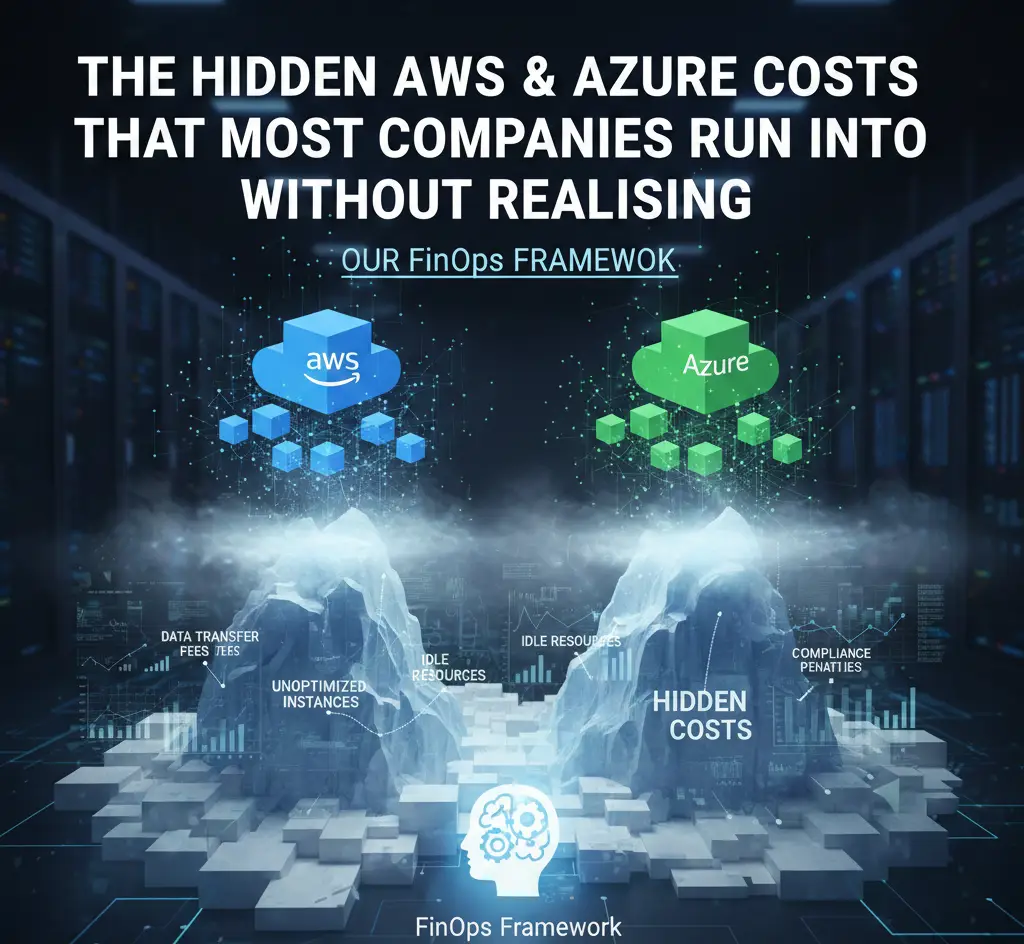
Most companies believe they have their cloud spend figured out, right until the bill shows up.
They even use the most detailed cloud provider dashboards to track their usage, yet hidden AWS & Azure costs keep quietly ballooning their monthly invoices. These costs don’t come as clear line items and are frequently disregarded until they start affecting margins, runway, or profitability.
A simple truth: cloud costs don’t explode overnight—they leak slowly.
This piece reveals the hidden AWS and Azure costs most companies run into and explains how our FinOps framework sorts them out for good.
Why AWS & Azure Costs Are Such a Challenge to Control
Cloud platforms are amazing, but they are complicated. Costs are based on usage, split across services, and change dynamically. Without strict financial governance, organisations tend to rely on occasional cost audits rather than having full control over the costs.
As a result, hidden expenses come to the surface.
Hidden AWS & Azure Costs Most Companies Miss
1. Idle Compute Instances
One of the most typical hidden costs associated with cloud is the idle computer:
- EC2 instances or Azure VMs operating at low utilisation
- Dev, staging, or test environments left turned on
- Instances prepared for peak load, running 24/7
The capacity that is allocated will be charged for, even if it is barely used.
2. Overprovisioned Storage
Storage seems cheap initially, but gradually it becomes a stealth cost contributor:
- Unused EBS disks and Azure Managed Disks
- Snapshots from the past are stored forever
- Logs and backups are saved at premium tiers
These expenses build up monthly without offering any value to the business.
3. On-Demand Pricing for Predictable Workloads
A lot of teams depend heavily on on-demand pricing even for predictable workloads. Without the usage of:
- Reserved Instances
- Savings Plans
- Long-term commitments
Companies end up paying 30–60% more than the optimised pricing models.
4. Data Transfer & Network Egress
Moving data between regions, services, or external platforms carries hidden charges:
- Cross-region traffic
- Outbound data transfers
- Inter-service communication
These fees are often overlooked, but they increase rapidly with more usage.
5. Orphaned Resources
Infrastructure keeps changing, and some resources are disconnected but not deleted:
- Unattached storage volumes
- Load balancers without traffic
- Old IP addresses
They quietly live on your account, charging you every month.
6. Lack of Cost Allocation
Whenever cloud costs are not tagged or divided properly:
- Teams are unaware of their consumption
- There is no accountability
- Overspending happens without anyone noticing
This is one of the major reasons for the rapid growth of cloud costs without control.
Why Conventional Cost-Cutting Strategies Fail
Some organisations try to manage expenses by:
- Periodic cleanups
- Manual audits
- One-time fixing
The drawback of this method is that cloud environments change every day. What you saved last month can come back the next month if you don’t fix the underlying issue.
How Our FinOps Framework Keeps Hidden Cloud Costs at Bay
Our FinOps framework is aimed at continuously cutting hidden AWS & Azure costs to zero rather than temporarily.
1. End-to-End Cost Visibility
This is where our journey starts, with absolute transparency:
- Breakdown of costs by service
- Spending based on the environment
- Allocation at the level of team and product
This helps to turn cloud bills into insightful details.
2. Cost Allocation & Ownership
With tagging and allocation techniques, we link the costs to:
- Teams
- Products
- Business units
Once the teams have a clear picture of the real costs, they naturally change their spending habits for the better.
3. Continuous Optimisation (Not One-Time Fixes)
The FinOps framework is all about continuous optimisation:
- Adjusting the size of compute and storage
- Getting rid of idle and orphaned resources
- Making the pricing plans optimal
According to reports, most companies witness 20–40% continuous savings.
4. Budgeting, Alerts & Forecasting
We set up:
- Budget thresholds
- Real-time alerts
- Forecasting dashboards
These help you to avoid unexpected bills and enhance your financial planning.
5. Governance Without Blocking Innovation
FinOps is not about restricting teams. Our framework:
- Promotes making wise architectural choices
- Maintains a balance of performance and cost
- Enables quick delivery while exercising financial discipline
Innovation continues—just without waste.
Who Most Benefits from This FinOps Framework?
The method works best for:
- AWS or Azure native SaaS solutions
- Startups with financial runway concerns
- Enterprises with highly complex cloud situations
- CTOs and CFOs looking for predictability
- DevOps teams handling scaling infrastructure
Cloud bills are increasing every month without a clear growth explanation, pointing directly to hidden costs.
FAQs – Hidden AWS & Azure Costs & FinOps
Why don’t AWS and Azure have a more transparent way of showing hidden costs?
They do provide the data, but without things like context, allocation, and analysis, most inefficiencies remain hidden.
How much can FinOps reduce AWS & Azure costs?
Generally, enterprises enjoy 20-40% cost savings within 30-90 days of implementing FinOps.
Is FinOps only about saving money?
Certainly not. FinOps is about making the cloud spend a business driver while simultaneously ensuring performance and growth.
Does FinOps slow down development teams?
Not necessarily, FinOps actually enhances cloud decision-making.
Is FinOps a one-time project?
FinOps is an ongoing process that changes with your infrastructure.
Turn Hidden Cloud Costs into Controlled Spending
If you think your cloud bills keep going up because of hidden AWS & Azure costs, then maybe it’s time to stop guessing.
An advanced FinOps framework will give you:
- Visibility
- Accountability
- Predictability
- Sustainable cloud growth
Schedule a FinOps evaluation now and find out what is not being told by your cloud bill.