
From Reactive Monitoring to Predictive Operations: How AIOps Has Changed Incident Management in 2026

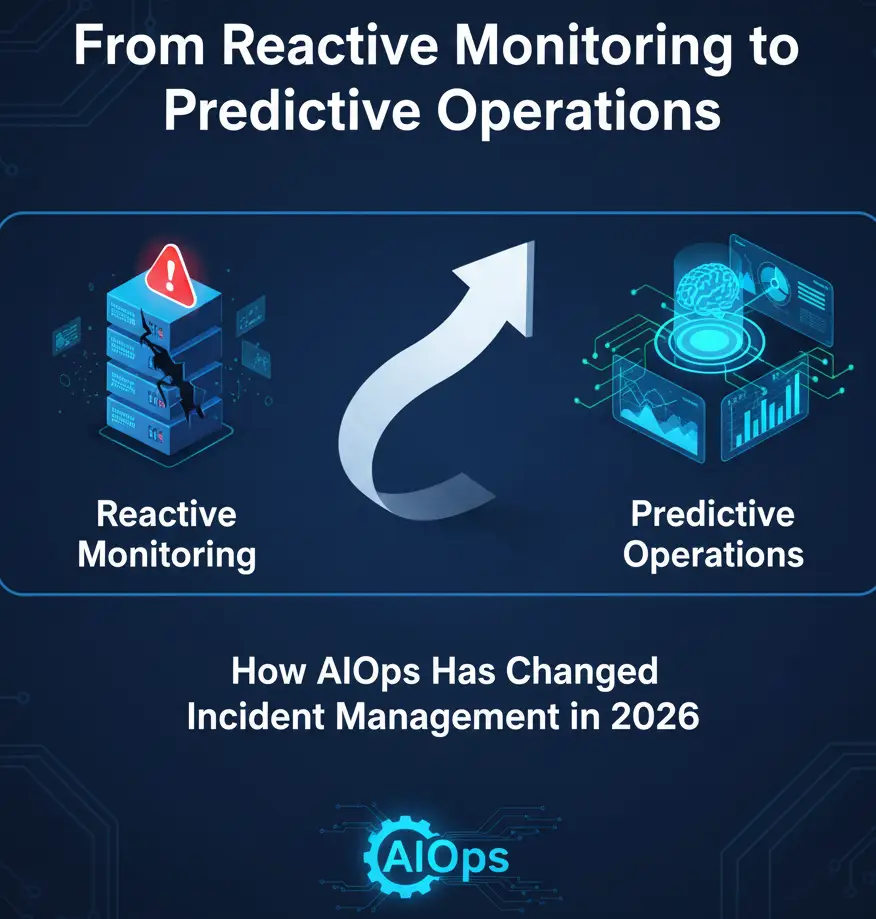
For many years, DevOps teams got by with reactive monitoring and incident management. The alerts came only after the failures; the engineers were in a rush to find out the root cause, and, in the meantime, the business teams faced the consequences of the downtime and losses in revenue. Although the method was functional at a small scale, it is no longer suitable for today’s complex, distributed environments.
Fast forward to 2026, and modern businesses don’t just talk about how quickly they can react to incidents. Instead, they seriously consider the reasons behind the incidents. It is this change in attitude that accounts for the widespread use of AIOps predictive incident management in 2026, which sees the teams preventing the problems before the users are affected.
Why Reactive Monitoring Is Ineffective at Large-Scale
Reactive monitoring works by setting predetermined thresholds and relying on human help. However, as the IT landscape becomes increasingly complex with microservices, Kubernetes, multi-cloud deployments, and serverless functions, these fixed rules only result in generating a lot of noisy alerts.
Through the screens filled with alerts, the engineers get exhausted, overlook the important ones, and spend extra time figuring out the symptoms rather than the actual issues. At the same time, the problems grow more severe and quicker than the teams can react to them.
Conventional monitoring systems make the teams aware that something is wrong. They hardly ever indicate the reasons for the failure or the subsequent issues. When dealing with large volumes of data, this shortfall of traditional monitoring systems will turn into a risk to the business and not just an inconvenience for the IT department.
This is the main motive of companies integrating AI to their operations for future predictive incident management.
What Does AIOps Have To Offer For Contemporary DevOps?
Basically, AIOps is an umbrella term for artificial intelligence, machine learning, and data analytics that are leveraged to automate IT operations and incident management. AIOps doesn’t limit itself to a few metrics, but it continuously analyses logs, measures, tracks, and monitors events across different systems.
In contemporary DevOps, AIOps tools for DevOps operations facilitate the following:
- Real-time anomaly detection
- Event correlation across a complex system
- Automatic root cause identification
- Prediction of incidents beforehand
By being fed on both historical and real-time data, AIOps platforms learn and get better so as to not only save engineers from the tedious task of dealing with unnecessary alerts but at the same time improve accuracy.
The Mechanics of Predictive Operations
Predictive operations take the key idea of being less reactive and more preventive. AI models are used to analyze data not only from the infrastructure level but also from the applications and user behaviours to figure out the possible warning signs.
Suppose an AIOps detects the initial rise of a few milliseconds in the time taken to respond, as well as other indicators of memory leak and unusual traffic patterns that in the past have led to a service outage. The system, by then, will have activated the 2 a.m. squads with such a detailed story that they can fix the problem within minutes.
What this means is that with the help of AI, incident avoidance will become the norm rather than the exception in DevOps, where teams will resolve problems while the impact is low and not wait for disruptions to reach maximum level.
AI Methods Applied in AIOps
There are quite a few leading AI techniques that AIOps banks on to provide very predictive insights:
- Anomaly detection: Observation that deviates from the regular behaviour of a given system is flagged.
- Event correlation: Connecting various related alerts coming in from different tools, it helps in identifying the root cause point.
- Machine learning forecasting: From present condition and the past know-how, it tries to predict capacity, performance, and overrun risks.
- Noise reduction: Earmarking of truly poor-performing issues through persistent filtering of redundant alerts.
These AI techs are really the workhorses behind the shift from predictive monitoring to traditional monitoring and, in fact, swap static rules with smart and intelligent adaptive capabilities.
Business Impact: MTTR, Uptime, and Cost Reduction
The business-friendly touch of AIOps is quite clearly revealed through the back-end servicing of AIOps-powered predictive incident management.
AIOps-enabled organisations:
- Reduce MTTR using AI DevOps by speeding up the entire cycle of identifying, diagnosing, and resolving issues.
- Besides achieving a better system uptime, use an early warning system to continuously keep the environment healthy.
- Cut down operational expenses through automating investigations.
- Minimise the loss of revenue caused by outages.
- Raise customer satisfaction and build loyalty.
As an increasing number of executives are shifting their perception, AIOps is no longer seen just as an IT upgrade but more as a strategy to protect the revenue.
AIOps Use Cases in the Real World
The largest and most successful enterprises utilise AIOps capabilities in different departments of their DevOps:
- Proactive incident prevention: The detection of signs of a breakdown before the service deteriorates
- Root cause analysis: Automatically pinpointing the component failure
- Capacity optimisation: Being able to foresee the infrastructure needs and hence, preventing the overload
- Release stability monitoring: Getting the signs of a risky deployment early
It is quite clear that, with the help of AIOps, the employee’s mindset transitioned from just doing what is necessary to maintaining a continuous flow of improvement, thereby leading to enhancing the overall quality of the product/service.
Challenges and Adoption Strategy
Just like any other transformative technology, AIOps has to face and overcome a menacing beast of challenges if it is to continue to grow and even bring more benefits to the corporate world. Data inconsistencies, excessive tooling, lack of trust in automation, etc. – all these disruptions slow down progress.
Winning teams identify, strategize, and create a plan for overcoming obstacles:
- Centralising observability data
- Starting with noise reduction and anomaly detection
- Integrating AIOps into existing DevOps workflows
- Gradually automating responses once accuracy improves
Rather than an abrupt replacement of systems, adoption is most effective when viewed as an evolutionary process.
The Future of Incident Management in 2026
Incident management in 2026 is hardly any longer about dashboards and alerts. Instead, AIOps systems will have learnt to constantly learn, predict, and act, often without the need for a human being.
DevOps teams change their roles from firefighters to optimisers. AI takes over the simple steps of detection and response while engineers get involved more in reliability engineering and innovation.
Predictive operations will not be seen as an optional feature but rather as a core capability in DevOps.
FAQs: AIOps and Predictive Incident Management
1. What is AIOps predictive incident management?
AI-based predictive incident management, which is AIOps, aims at forecasting and consequently preventing the occurrence of a failure or an incident that will disturb the working of a system or influence the users.
2. How does AI-driven incident prevention in DevOps work?
AI harnesses the power and intelligence of the past data as well as the present in order to forecast the signs of a problem not only locally but also globally, thus automatically carrying out preventive measures at the right place and time.
3. What is the difference between predictive monitoring and traditional monitoring?
The two are quite different. The former foresaw the coming requirements and thus put preventive measures in place, whereas the latter just portrays the present scenario or acts on failures only.
4. Are AIOps tools suitable for all DevOps teams?
Definitely, for any size, irrespective of whether the teams are small or big, they all stand to benefit from using AIOps, especially if they are dealing with complex and/or distributed environments.
5. Can AIOps really reduce MTTR using AI DevOps?
By simply taking the tedious work out of detecting, correlating, and then analysing the root causes, AIOps can indeed significantly bring down the mean time to resolution (MTTR).