
AI-Driven DevOps: How AIOps and Predictive Automation Will Shape Software Delivery in 2026

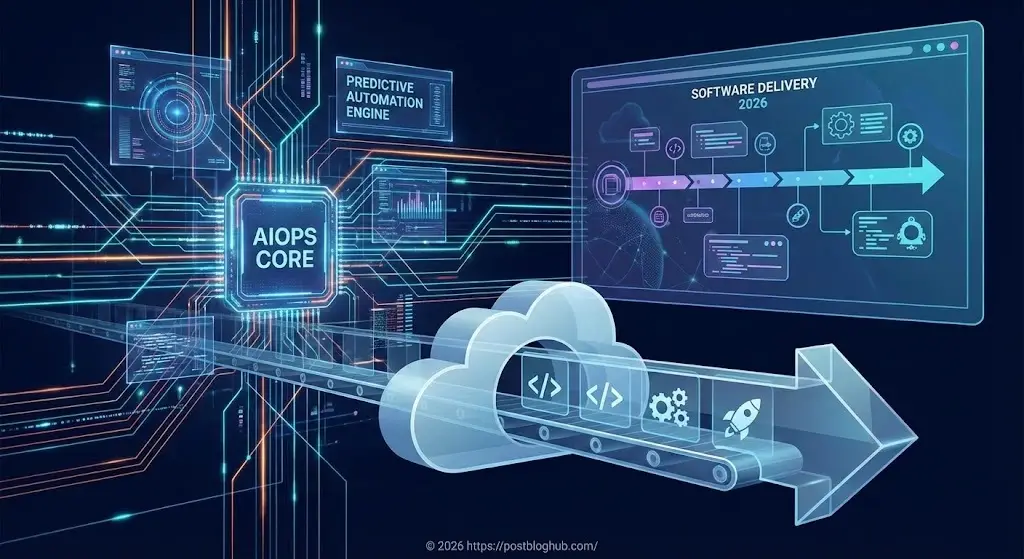
Software delivery in 2026 is fundamentally different from what it was a few years ago. Speed alone is no longer the only goal. Today, engineering teams prioritize reliability, intelligence, security, and predictability. AI-driven DevOps, powered by AIOps and predictive automation, is the core of this transformation.
When systems become more complex and release cycles are shorter, traditional DevOps ( https://aws.amazon.com/devops/what-is-devops/ ) tools find it hard to cope. Manual monitoring, reactive incident response, and rule-based automation do not scale anymore. That is why artificial intelligence is introduced here—not to replace DevOps teams, but to serve as a great accelerator.
Here we will discuss the AI integration in DevOps pipelines, predictive bug detection, and automation, and how they are transforming software delivery in 2026.
What Is AI-Driven DevOps?
AI-Driven DevOps ( https://www.ibm.com/think/topics/aiops ) is a mixture of machine learning, data analytics, and automation with DevOps practices. It is a switch from reacting to failures to predicting them, automating decisions, and continuously optimising pipelines.
AIOps (Artificial Intelligence for IT Operations) is the use of AI to analyse vast amounts of operational data, from logs and metrics to deployment events and user behaviour. It detects patterns that humans are not fast enough to spot and translates the insights into actions.
Simply put:
- DevOps carries out workflows
- AIOps thinks, learns, and optimizes them
Why AIOps Matters More Than Ever in 2026
The applications in the present day run not only on the cloud but also on hybrid and multi-cloud environments. They are based on containers, microservices, APIs, and third-party integrations. All this makes the generation of data so massive that it is overwhelming.
This is where AIOps assists the teams:
- to manage the overload of alerts
- to spot anomalies independently
- to correlate issues across the systems
- to make decisions more rapidly and based on data
In 2026, DevOps without AI turns out to be a hindrance, while AI-powered DevOps turns out to be a competitive edge.
AI Integration in DevOps Pipelines
Nowadays, AI is a major character throughout the entire DevOps lifecycle ( https://www.atlassian.com/devops ), from planning to production.
1. Intelligent CI/CD Pipelines
AI-powered CI/CD pipelines make automation go further. They:
- Check the history of builds and deployments
- Judge the riskiness of the commits
- Choose the best time for deployment
- They also automatically rollback a release if anomalies show up
This cuts down the number of failed deployments and makes the releases more fluent.
2. Smarter Code Reviews
AI tools look into the code for:
- Performance problems
- Security loopholes
- Code and design issues that contribute to technical debt
And they do it based on the defect history, so the suggestions are very close to the context of the problem. That is a big help for the developers in saving the time they would normally spend on manual review.
Predictive Bug Detection: Fixing Issues Before Users Notice
One great benefit of AI-Driven DevOps is predictive bug detection.
With the help of AI models, bugs can be channelled away from production:
- Study the code repository and coding methods
- Point out the vulnerable parts
- Anticipate bugs before testing even begins
In 2026, teams shift their mindset from “What broke?” to “What is likely to break next?”
This strategic move:
- raises the bar on the quality of software
- lowers the risk of downtime
- builds a stronger relationship with customers
Predictive Automation in Incident Management
Traditionally, monitoring tools overwhelm teams with alerts. AI-Driven DevOps keeps a lid on it by incorporating predictive automation.
This is the flow of the process:
- AI picks out the signs of trouble quite early
- It combines the signals from different levels such as infrastructure, applications, and networks
- The automation takes over and performs the fixing operations immediately
Here are a few examples:
- Automatically adjusting the capacity before a traffic surge
- Restarting a failing service without letting the users be aware of it
- Stopping the attack even before it becomes a security incident
Such a solution leads to a great reduction in MTTD (Mean Time to Detect) as well as MTTR (Mean Time to Resolve).
AI-Powered Observability and Root Cause Analysis
The 2026 observability is much more than just having a few dashboards.
AI makes a perpetual examination of:
- Logs
- Metrics
- Traces
- User experience data
In instances of failures, AI immediately identifies the root cause, even down to the specific service, change, or configuration.
Hence:
- Fewer war rooms
- Faster recovery
- More confident releases
Automation at Scale: From Scripts to Self-Healing Systems
In the beginning, automation in DevOps meant only scripts and hardcoded rules. Self-healing systems are now a reality thanks to AI.
These systems:
- Understand what is normal behaviour
- Notice when there is a deviation
- Take self-correcting actions
Examples of the common use cases include:
- Automatically scaling the infrastructure
- Smartly distributing the load
- Efficiently patching security vulnerabilities
- Constantly tuning the performance
Teams with a high-performance level in 2026 dedicate less of their time to firefighting and more on innovation.
Business Impact of AI-Driven DevOps
AI-Driven DevOps leads to tangible business benefits, besides the technical improvements.
It is through:
- Speeding up the time to market
- Increasing the rate of successful deployments
- Reducing the costs of operation
- Enhancing the reliability of systems
- Offering a great customer experience
In a competitive market, all these things translate directly into the growth of revenue and the loyalty of customers.
Preparing Your DevOps Strategy for 2026
Successful adoption of AI-Driven DevOps requires:
- Tight integration of operational data
- Observability as a prerequisite to automation
- Use of predictive cases as a starting point
- Human expertise and AI collaboration
- Developing confidence in automated decisions
AI is most effective when it is led by the teams rather than dreaded by them.
Final Thoughts
AI-Driven DevOps is not just a concept; it is the now and the future of software delivery. AIOps and predictive automation in 2026 will be the new standard for the teams that build, deploy, and maintain applications.
Those organisations that take on AI now will be able to deliver at a higher velocity, make fewer mistakes, and grow more intelligently. On the contrary, the ones that don’t will find themselves lagging behind.
It is no longer a question of whether to adopt AI-Driven DevOps, but rather, how quickly you can start the journey.