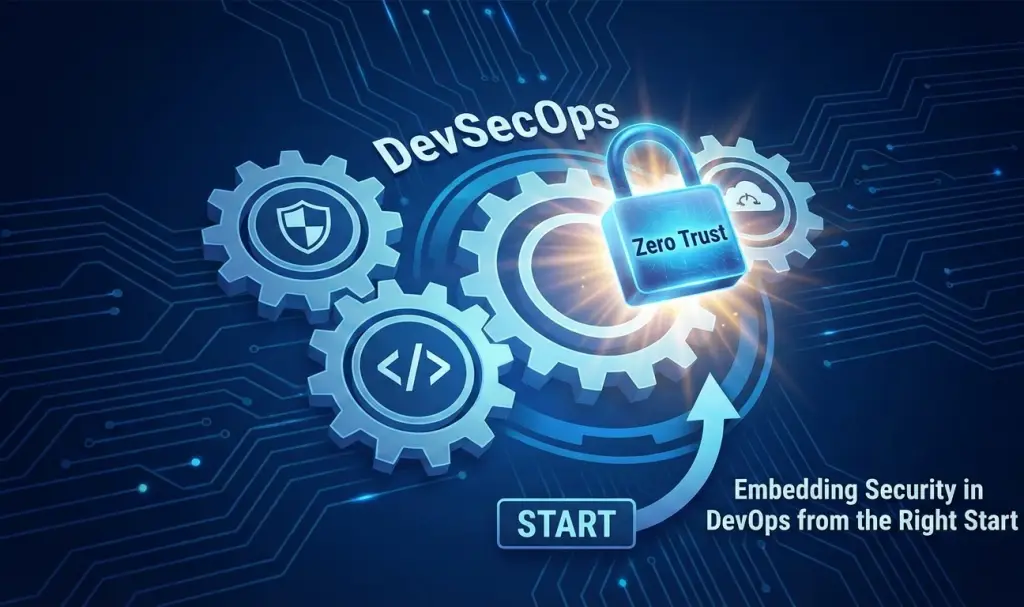
By 2026, the notion of security being an afterthought in software development would have become obsolete. Cybercriminals exploit vulnerabilities more creatively, cloud environments are increasingly intricate, and product release cycles are quicker than ever before. Under these circumstances, traditional security models are simply not efficient enough to cope with the challenge.
For these reasons, DevSecOps and Zero Trust have emerged as essentials. They combine to facilitate organisations to incorporate security into DevOps workflows right from the start, instead of patching up vulnerabilities post-deployment.
Development with a security-first mindset is no longer just an option. It has become a necessity for the survival of businesses.
What Does DevSecOps Mean?
DevSecOps is the principle of bringing security up to speed with each stage of the DevOps development cycle.
Rather than segregating security as a final checkpoint, DevSecOps turns it into a collective responsibility for the development, operation, and security employees.
Under a DevSecOps framework:
- Developers embed security in the code from the initial stage
- Security checks are triggered automatically in CI/CD pipelines
- The operations team implement security policies at runtime
Such methodology allows teams to be agile without trading off on security.
How Does Traditional Security Fail in the Modern DevOps?
Traditional security:
- places heavy reliance on manual inspections
- Focuses on late-stage penetration testing
- Requires centralised approval for security measures
These methods often frustrate teams, delay release schedules, and allow security vulnerabilities to slip through during the early stages of the development lifecycle.
Modern applications update so frequently that teams can no longer rely on reactive security measures. By the time a vulnerability appears in the production environment, attackers have often already exploited it and caused damage.
DevSecOps comes with a solution in the form of shift-left security.
Shift-Left Security: Locking Down Code at the Earliest Stage
In essence, shift-left security integrates security features directly into the development process, starting at the developer and source code level.
Instead of raising the question, “Will this be secure after release?” the team changes the question to “Is this secure before production?
Some of the main shift-left initiatives encompass:
- Static application security testing is integrated within the coding process
- Scanning dependent and open-source software for vulnerabilities
- Performing infrastructure coding security checks
- Secrets detection automation
Because the fixes are made at the earliest point possible, the cost of remediation is significantly lower and the time to market is faster.
Zero Trust Security: What Is It?
The fundamental principle of Zero Trust is:
Never trust, always verify.
Under the Zero Trust framework:
- By default, no user, device, or service is trusted
- Each request is authenticated and authorised
- Access is limited only to what is required
The model is well-suited to cloud-native and distributed systems where traditional network perimeters are no longer identifiable.
Zero Trust has become one of the underlying pillars of modern DevSecOps strategies by 2026.
The Collaboration Between DevSecOps and Zero Trust
DevSecOps spells out the method of bringing security into workflows, while Zero Trust, on the other hand, delineates the ways in which trust and access are managed.
When united, they produce an extremely efficient and security-first delivery model:
- Developers commit code changes to the version control system
- Automated security scans are executed by the CI/CD pipelines
- Zero Trust access controls are enforced by policies
- Only code that has been checked and found to comply with the standards, gets deployed
- After deployment, runtime monitoring keeps behaviour verification on-going
Such a method narrows down the points of attack and contains the extent of the breach if it does occur.
Security-First Workflows in DevOps
High-performing teams, as of 2026, adhere to security-first DevOps workflows such as:
Secure CI/CD Pipelines
Security apparatus is incorporated seamlessly into build and deployment pipelines, thereby automatically preventing insecure code from getting through.
Infrastructure as Code Security
Pre-deployment scanning of Terraform, CloudFormation, and Kubernetes manifests for misconfiguration is the norm among teams.
Identity-Centric Security
Instead of focusing on the network location, which can change, Zero Trust shifts the attention to the identity; hence, secure access across environments is guaranteed.
Continuous Monitoring
Artificial intelligence-based tools are capable of identifying unusual, potentially malicious behaviours in the same instant that they occur.
Security is unnoticeable, yet it is always there.
What Are the Business Benefits of DevSecOps and Zero Trust?
The implementation of security-first DevOps provides unambiguous business value:
- Accelerated and more reliable product releases
- Decrease in the number of security incidents
- Reduction of remediation costs
- Simplified regulatory compliance
- Increased customer loyalty
Those organisations that embrace DevSecOps practices ahead of the competition will not only enjoy the benefits of protected systems, but their brand image will also be spared.
Common Challenges (and How to Overcome Them)
Challenge: Developers view security as an obstacleSolution: Security automation on the one hand and fast feedback on the other hand will help developers!
Challenge: There is an overload of security tools. Solution: Determine the major among the many platforms and set a standard!
Challenge: Security skills are not adequate. Solution: Promote and encourage the culture of shared responsibility and facilitate a training program!
DevSecOps works best when security measures are at the service of the teams and not the other way around.
Conclusion
DevSecOps and Zero Trust in 2026 are security frameworks that have significantly changed software development.
They are a decorum of features: proactive protective measures instead of reactive, automated checks instead of manual ones, and verification instead of assumptions.
Day one of DevOps shall be the day for security; therefore, security becomes an enabler of fast, scalable, flexible systems that are also secure.
Security no longer stands in the way of speed.
DevSecOps makes it a source of confidence and, consequently, growth.
FAQs: DevSecOps and Zero Trust
1. What is the main goal of DevSecOps?
The main goal of DevSecOps is for teams to consider security as an integral part of the DevOps phases, starting from development.
2. How Does Shift-Left Security Help Teams?
Shift-left security helps teams identify and address security flaws at an early stage, which leads to cost reduction, less risk, and no more postponements.
3. Is Zero Trust Only for Large Enterprises?
Zero Trust is not limited to large enterprises only. It is particularly beneficial for small and medium-sized businesses that have adopted a cloud and remote access strategy.
4. Does DevSecOps Slow Down Development?
DevSecOps, when implemented appropriately, accelerates product delivery by automating security verification and minimising rework.
5. Can DevSecOps Help with Compliance?
Definitely. DevSecOps aids compliance efforts by providing clear and documented audit trails, enforcing policies, and automating compliance continuously.