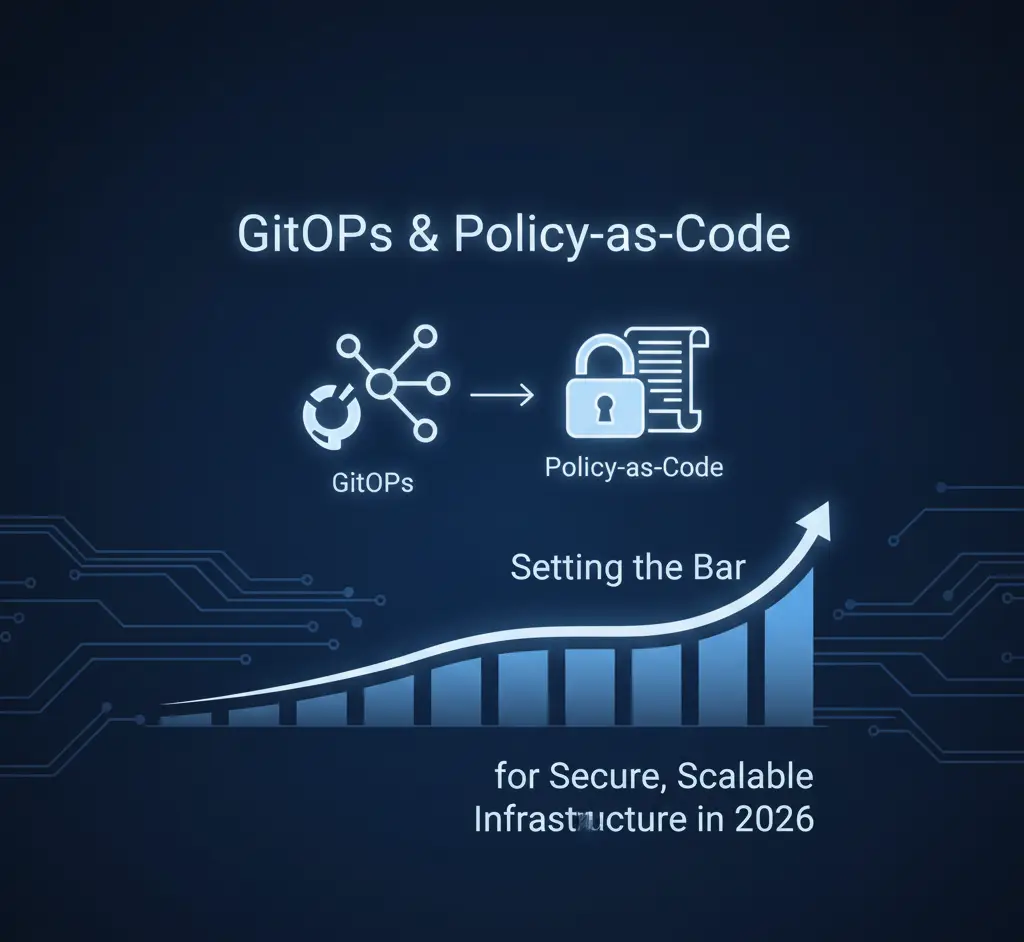
There has been a complete overhaul in infrastructure management over the past 10 years. Old ways of working, like carrying out manual configurations, approvals through tickets, and dealing with environments drifting, are no longer excuses for a world of cloud-native applications and continuous delivery. Organizations in 2026 require the ability to deliver fast, be secure, have consistent processes, and get large-scale results—all at once.
This is the main reason why GitOps and Policy-as-Code have evolved from being “best practice” to the industry standard.
Individually, these practices create a modern operating model where teams version-control the entire infrastructure, automate every process, maintain full auditability, and build security directly into the system.
What Does GitOps Mean?
GitOps is a methodology for managing not only infrastructure but also applications by using Git as the single source of truth. Teams make every change—whether they adjust the infrastructure, deploy an application, or update the environment—through a Git commit.
You don’t have to log into servers or cloud dashboards anymore:
- Your desired state is something you write down in code
- You keep it in Git
- Automated systems take care of and reconcile it
When the real state of the world varies from the desired one, GitOps software will identify it and rectify the situation without human intervention.
GitOps in 2026 is a must-have instead of a nice-to-have if you want to be able to scale DevOps and platform engineering.
What Made GitOps Become an Everyday Solution by 2026
GitOps gets into the mainstream due to several factors:
1. Extraordinary Complexity of Cloud and Kubernetes
The contemporary applications work on multiple clusters, locations, and cloud providers. By enforcing consistent and repeatable deployments, GitOps becomes a source of order.
2. Deployments that Are Faster and Safer
Workflows based on Git are recognizable tools to developers. As a result, teams lower barriers, shorten release cycles, and minimise human errors.
3. Auditing as an Inherent Feature
Along with every change, there is a commit history. Teams already have the knowledge, from a compliance and governance point of view, of who changed what, when, and why.
4. Scale Automation
GitOps empowers fully automated infrastructure provisioning and application delivery, with no loss of control.
What Does Policy-as-Code Involve?
Policy-as-Code encodes security, compliance, and governance rules directly into program code instead of relying on manually followed documents or checklists.
Those policies:
- Are co-located with application and infrastructure codes
- Are executed automatically during CI/CD pipeline runs
- Prevent ill-compliant changes from being deployed by blocking them
Policy-as-Code is the DevSecOps, zero-trust security, and compliance with regulations backbone in 2026.
Reasons Why Embedding Policies as Code Matters in 2026
Up until now, traditional governance was based on manual inspections and ex-post audits. It is impossible for that type of approach to work at the speed of present-day DevOps.
Thereby, Policy-as-Code brings a shift to the left of governance.
The most important benefits are:
- Security rules are automatically enforced
- Compliance is constant in all environments
- There are fewer incidents in production
- There is less reliance on manual approval processes
This approach transforms security specialists from gatekeepers who stop progress into enablers who actively help teams move forward.
GitOps & Policy-as-Code: The Perfect Harmony
GitOps specifies the deployment process while Policy-as-Code determines the set of permitted changes.
They complement each other to form a robust system:
- Developers propose changes through Git
- CI pipelines check the validity of the code and the policies
- Policy engines verify security and compliance
- Changes that have been approved are the only ones that get deployed automatically
- GitOps continuously reconcilesthe actual vs desired state
This approach balances speed and safety, creating the kind of infrastructure management teams aim for.
2026: Key Use Cases
Secure Cloud Infrastructure
Automatically enforce rules like encryption, access controls, and network isolation.
Compliance-Ready Deployments
Fulfil the requirements of standards like ISO, SOC 2, HIPAA, and GDPR by using policies written in code.
Multi-Cloud and Hybrid Consistency
The same policies are extended to AWS, Azure, GCP, and on-premises environments.
Platform Engineering
Internal developer platforms leverage GitOps and Policy-as-Code to provide developers with self-service infrastructure while having tight control.
Business Impact of GitOps & Policy-as-Code
In adopting this model, companies witness tangible business outcomes:
- Shorter release cycles
- Less risk in operations
- Fewer security breaches
- Audit and compliance processes made easy
- Developer experience enhanced
In 2026, the depth at which an enterprise integrates GitOps and Policy-as-Code will determine its DevOps maturity.
Common Challenges (and How Teams Solve Them)
Challenge: Cultural resistance
Solution: Start at a small scale and demonstrate fast results
Challenge: Policy complexity
Solution: Write simple, incremental policies
Challenge: Tool sprawl
Solution: Standardise workflows and platforms
The key to GitOps success is for teams to view it as an operating model rather than simply a set of tools.
Conclusion
GitOps and Policy-as-Code have revolutionized the way infrastructure is managed in 2026. They supersede manual intervention with automation, disorder with consistency, and risk with trust.
As a unit, they secure and scale the software delivery pipeline for a new era of digital transformation.
If you do not drive your infrastructure through Git and govern it with code-based policies, you already lag behind.
FAQs: GitOps & Policy-as-Code
1. Are Kubernetes and GitOps the only pair?
This is not the case. GitOps initially was related to Kubernetes only, but presently it is also utilised for cloud infrastructure, CI/CD pipelines, and platform engineering.
2. What distinguishes Policy-as-Code from conventional security reviews?
Policy-as-Code enforces rules during development and deployment, eliminating reliance on manual post-change reviews.
3. Is it possible for GitOps to enhance security?
Definitely. GitOps helps implement version control, manage access, automate processes, and integrate with Policy-as-Code, all of which contribute to better security.
4. Does GitOps make the process of development slower?
Not at all. The truth is, it accelerates development by getting rid of the manual stages and thus making the deployments more predictable and repeatable.
5. Will GitOps be beneficial for large organizations?
Yes, indeed. It should be noted that the biggest advantages of GitOps appear in regulatory and compliance-heavy environments, which are typically complex and large.