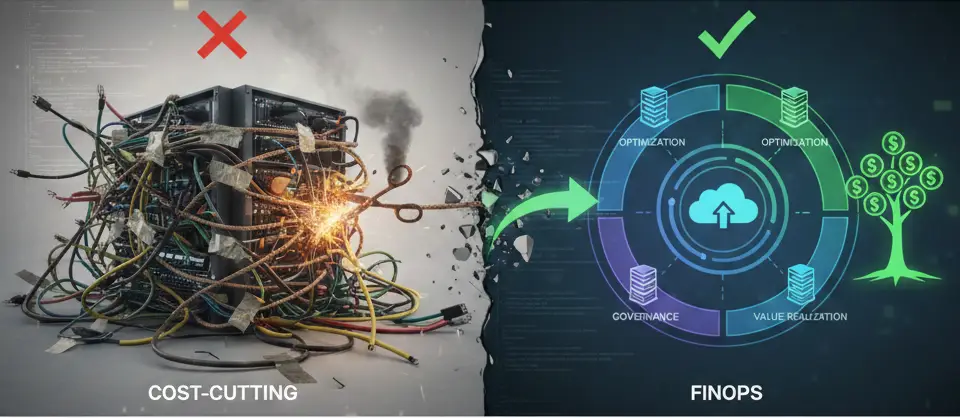
For many organisations, the very first step when cloud bills start to skyrocket is very clear: cut costs. Teams go at it one by one, deleting resources, downsizing infrastructure and freezing deployments—basically, they are hoping to lower monthly cloud spending really fast.
However, very soon after, cloud costs increase again. The performance issues resurface, engineering teams get stuck, and the same problems come back. Basically, this is the way that cost-cutting in the cloud fails without FinOps.
Cloud cost challenges are not a budgeting problem—they are a governance and visibility problem. Cost reduction endeavours, by nature, are reactive, temporary, and often very damaging without FinOps.
The Downside of Traditional Cloud Cost Cutting
Most companies treat cloud costs like traditional IT expenses. This line of thought fails since the cloud works by different rules.
1. The Cloud Infrastructure Is Always Changing
Simply put, cloud environments are constantly changed, unlike on-premise systems:
- Resources spin up and down automatically
- Teams deploy frequently
- Usage fluctuates based on traffic and workloads
One-off cost-cutting doesn’t consider the constant change.
2. Cost-Cutting Without a Proper Understanding
When finance teams, lacking a technical context, try to reduce costs, they:
- Forget that the removed resources were critical for performance
- Hinder innovation
- Cause outages or instability
Internal resistance and short-term savings at the cost of long-term efficiency become an outcome.
3. Cloud Spending Is Not Owned By Anyone
In most organisations:
- Engineering teams deploy resources
- Finance teams review invoices
- Leadership sees results too late
When there is no shared ownership, cost-cutting becomes a problem for others.
4. Time Healing Cuts
Even if costs are temporarily low:
- New services are deployed
- Auto-scaling adds capacity
- Test environments are recreated
If there is no system, savings will vanish in a matter of weeks.
The Costs of Cloud Cost Cutting That Lead to Other Risks
If cost-cutting is done blindly, it creates other issues besides money.
Performance Degradation
Slowing down a program later on may be just one of the results of software components removal without understanding the dependencies:
- Unhappy customer because of slow service
- Less trust in the service/product reliability
Engineering Frustration
Developers feel that financial constraints are becoming their enemies, and they even start to ignore them.
Slowed Growth
Cost cutting could stifle one most important and most precious things of startups and SaaS companies: Experimentation, innovation and scaling.
FinOps: What Has Been Missing in Cloud Cost Management
FinOps (Financial Operations) is a cloud financial management discipline that aligns finance, engineering, and operations teams.
It is not about keeping up with the cloud bills but rather using FinOps to support performance and growth while controlling costs continuously.
How FinOps Restores the Things Cost Cutting Destroys
1. Moving from Reactive Cuts to Continuous Optimization
Instead of depressing random cost cutting, FinOps brings about:
- Continual optimization
- Real-time visibility
- Intelligent, data-driven decision making
Cost saving is not synonymous with cost slashing.
2. Distribution of Cloud Usage Costs
FinOps tries to attach responsibility in a way that it is:
- By team
- By product
- By environment
Once teams know where the money goes to, naturally their behavior will change.
3. Having the Insight Before the Hand
FinOps offers clear insights into:
- Where is the money spent
- Why is it spent
- Which changes lead to cost saving
Decisions are no longer made based on guesswork.
4. Saving without Slowing Down the Performance
Dance FinOps revolves around:
- Rightsizing, not downsizing
- Removing waste, not value
- Aligning costs with usage
Thus, performance and reliability remain intact.
5. Budgeting & Forecasting with a Realistic Approach
FinOps allows for:
- Predictable budgeting
- Forecasting that is growth-oriented
- Instant alerts
Say goodbye to unexpected bills.
Cost Cutting vs FinOps: A Real Look at the Difference
Cost CuttingFinOpsOne-time actionContinuous processReactiveProactiveFinancial-focusedCross-functionalRisk to performancePerformance-safeShort-term savingsSustainable efficiency
Impacted Without FinOps
Startups are rapidly running out of cloud funds
SaaS companies are witnessing their margins getting tighter
Enterprises with complicated cloud environments
CTOs and CFOs having the need for cost predictability
The thing is, if cloud costs increase faster than business value, just cutting costs isn’t going to help.
Some cloud cost cutting & FinOps FAQs
Why isn’t cutting costs enough to reduce cloud bills permanently?
This happens because cloud environments are always in flux, and without any form of governance, costs resurface very fast.
Is saving money the only thing that FinOps is all about?
No. FinOps is about making sure that cloud expenditures deliver business value alongside performance and growth.
Can startups benefit from FinOps?
Absolutely! Initially, FinOps helps to protect the runway, and later on, it helps to prevent cost chaos.
Does FinOps slow down engineering teams?
FinOps helps teams to make more informed decisions while at the same time it does not hinder innovation.
What is FinOps – is it just a tool?
Whereas FinOps is a framework and an operational model that is supported by tools, processes and collaboration.
Stop cost cutting. Start cost controlling.
If cost-cutting in cloud is still failing, it is not the lack of effort; the problem is really the method.
The benefits that FinOps brings:
- Visibility
- Accountability
- Predictability
- Long-term cloud growth
Let’s say ‘yes’ to FinOps and make cloud costs a controlled, strategic investment and not a continual issue.