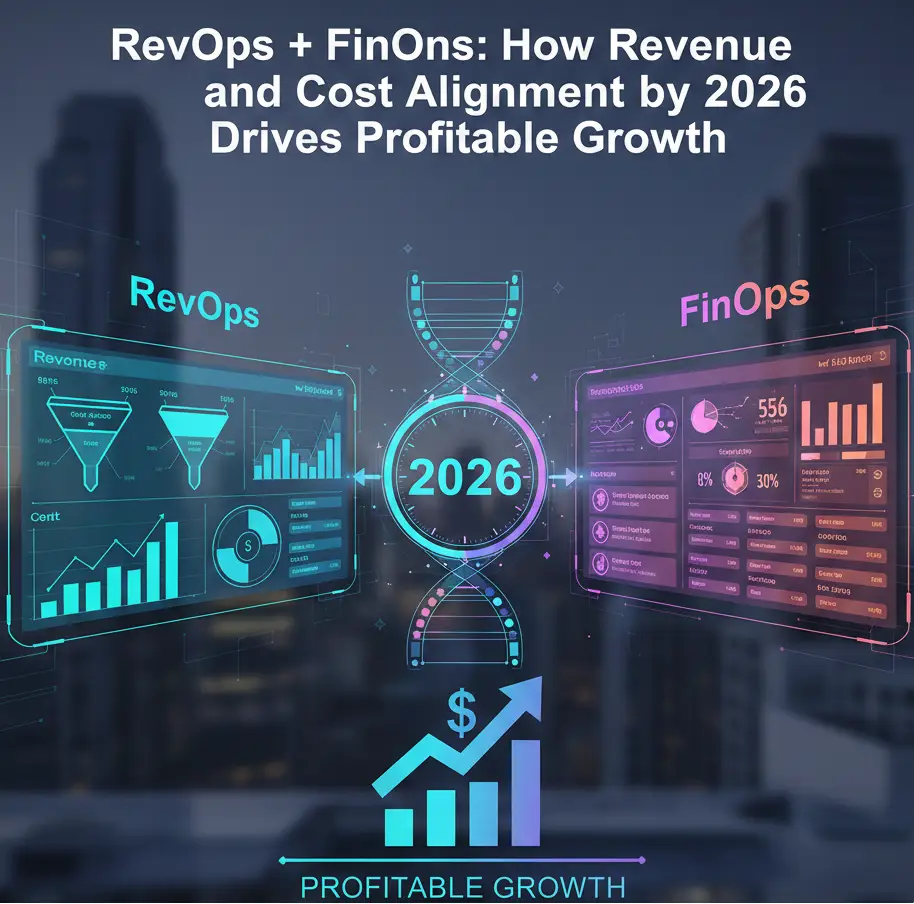
Growth itself no longer impresses founders, boards, or investors in 2026. Profitability does.
For the past few years, companies were obsessed with driving top-line growth, and at the same time, they treated costs as if they were a totally separate issue. That time has gone. Rising cloud expenses, longer sales cycles, and more restricted funding environments have compelled leaders to rethink their growth strategies. This explains why RevOps and FinOps are now viewed as a single entity.
When revenue and cost management teams align, organisations not only achieve quick SaaS momentum but also predictable, profitable SaaS growth.
Revenue Growth Without Cost Control Is a Recipe for Failure
Still, many companies are running their business with siloed systems:
- RevOps deals with pipeline, forecasting, and conversion
- FinOps concentrates on cloud spending, budgets, and optimisation
This division results in a lack of awareness. While the sales department is setting highly ambitious growth targets, the engineering team is scaling the infrastructure to be able to support those targets; it is the finance department which only finds out about the increasing costs too late.
Failure to integrate revenue and cost functions results in reduced margins being gradually eroded by growth.
Leaders in 2026 have realised that:
Essentially, all revenue has an associated cost, and if you disregard the cos,t then you are essentially destroying your company’s value in the long run.
True RevOps + FinOps Alignment
Growth is not a limiting factor if revenue and cost teams are aligned. It requires business intelligence to grow.
RevOps makes sure that through efficient teamwork, revenue is generated, converted, and retained.FinOps makes sure that the teams’ revenue production comes at an optimised cost.
As a result, they come up with a FinOps RevOps plan that responds to the following key questions:
- Which revenue streams generate the most profit?
- Which deals, customers, or segments are too costly to serve?
- How can we grow without the drain of margins?
This combined perspective is the hallmark of contemporary profitable SaaS growth.
The Transition From Growth-at-All-Costs to Revenue Efficiency
Acquisition volume and pipeline size were the major focuses for companies in their early days. However, in 2026, leaders give primacy to revenue efficiency.
Revenue efficiency represents the effectiveness with which a company converts its investments into sustainable revenue. It takes into account:
- Sales and marketing expenditures
- Cloud and infrastructure resources
- Customer support and success
- Expansion and retention effects
RevOps provides revenue generation visibility while FinOps reveals cost drivers. Their alignment converts such insights into tangible changes.
Why SaaS Unit Economics Matter More Than Ever
RevOps and FinOps alignment is deeply rooted in SaaS unit economics.
Top executives are now continually asking questions such as:
- What is the cost of acquiring and servicing one customer?
- Which customers, through their expansion, increase the profitability of the business and which do not?
- What is the impact of usage-based pricing on infrastructure cost?
If a company does not have this information, then their business might simply be losing profit even though their dashboards show growth.
In 2026, leading businesses are those that not only track unit economics continuously but also make go-to-market and infrastructure decisions based on them.
2. How RevOps and FinOps Align to Drive Growth and Profitability
1. Smarter revenue prediction features with a cost backdrop
Revenue volume is forecasted by RevOps, while FinOps weighs in on the cost implications. Thus, they come up with not only bookings but also profit-adjusted revenue forecasts.
By adopting this method, leaders get to:
- Stay away from growth which has a low margin
- Accurately plan infrastructure capacity
- Set profitability targets that are realistic
2. Pricing and packaging that help preserve margins
RevOps studies the behaviour of buyers and the structure of the deal, while FinOps assesses the cost related to a customer or usage tier.
When teams are in sync, they come up with pricing mechanisms that:
- Promote the desired pattern of usage
- Keep the unprofitable customers out
- Allow for cost-aware expansion
3. Sales and engineering collaboration
Whenever RevOps and FinOps join forces, the salespeople know the operational expense of the custom deals, and the engineers understand the revenue priorities.
That is a great way to prevent:
- Over-customisation
- Uncontrolled infrastructure scaling
- The resulting margin erosion gives rise to “one-off” deals
Cost-Conscious Growth as a Weapon
Cost-conscious growth does not imply slowing down the teams’ activities, but, instead, it ensures that growth is repeatable.
High performers in 2026, among other things:
- Consider revenue and cost impact in the evaluation of deals
- Focus on the customers with the best lifetime value and margin health
- Adjust infrastructure to the level of profitable demand
The way leaders define success has drastically changed by this attitude. Growth turns into an intentional, quantifiable, and lasting one.
The Metrics That Matter When RevOps Meets FinOps
Metrics linking revenue with cost are measured by aligned teams. Some of them are:
- Cost-adjusted net revenue retention
- Gross margin per customer segment
- Cost-to-revenue ratio
- Revenue per infrastructure dollar
- Payback period including operating expenses
These metrics form a communication network between RevOps, FinOps, finance, sales, and engineering.
Why 2026 Belongs to Aligned Revenue and Cost Teams
The companies are the ones that grow in an efficient manner, are transparent in their operations, and are responsible in their scaling, which markets in 2026 will reward. This can only be achieved through alignment, not just good tools.
A robust FinOps RevOps plan is a guarantee of:
- Revenue growth enabling profitability
- Cost optimisation supporting business initiatives
- Staff using shared data for decision-making
Such an alignment elevates RevOps and FinOps from ordinary operational support to being the driving force of strategic growth.
Conclusively: Profit Is the Result of Alignment
Profit does not just come about by chance. It is a result when revenue and cost teams collaborate as a single entity.
Those who manage to align RevOps and FinOps in 2026 will have found the key to growth clarity, control, and confidence. They will no longer be chasing flashy numbers on the dashboards but will be concentrating on creating sustainable businesses.
Profitable SaaS growth is the prize of those organizations which recognize revenue and cost as inseparable components and live that truth every day.
Frequently Asked Questions (FAQs)
1. Can you explain the meaning of RevOps and FinOps alignment?
Basically, RevOps and FinOps alignment teams integrate the aspects of revenue generation and cost control. RevOps is the function that oversees pipeline, forecasting, and conversions, whereas FinOps is the function that monitors infrastructure and operational costs to make sure that growth is profitable.
2. What is the significance of revenue cost alignment for SaaS companies in 2026?
A SaaS company can hardly go wrong with revenue cost alignment since it is imperative to break the vicious cycle of revenue growth chasing costs. It is a way to continuous growth without margin squeeze.
3. What is the impact of a FinOps RevOps strategy on revenue efficiency?
A FinOps RevOps strategy results in increased revenue efficiency through the integration of sales channels, deploying pricing strategies, and utilising infrastructure. This solution leads to a return on investments in growth initiatives.
4. What are the key metrics to consider when synchronising RevOps and FinOps?
The key metrics include SaaS unit economics, net revenue retention after deducting cost, gross margin per segment, and cost-to-revenue ratio. These metrics help the company to make the right growth decisions with an awareness of the cost involved.
5. How can cost-aware growth help a company outmatch its competitors?
Effectively, cost-conscious growth strategies are instrumental in enabling companies to scale rationally by focusing on top-line revenues with high margins and keeping tight control on operational expenses. Such a model will lead to increased profitability, better resilience, and long-term sustainability in 2026.