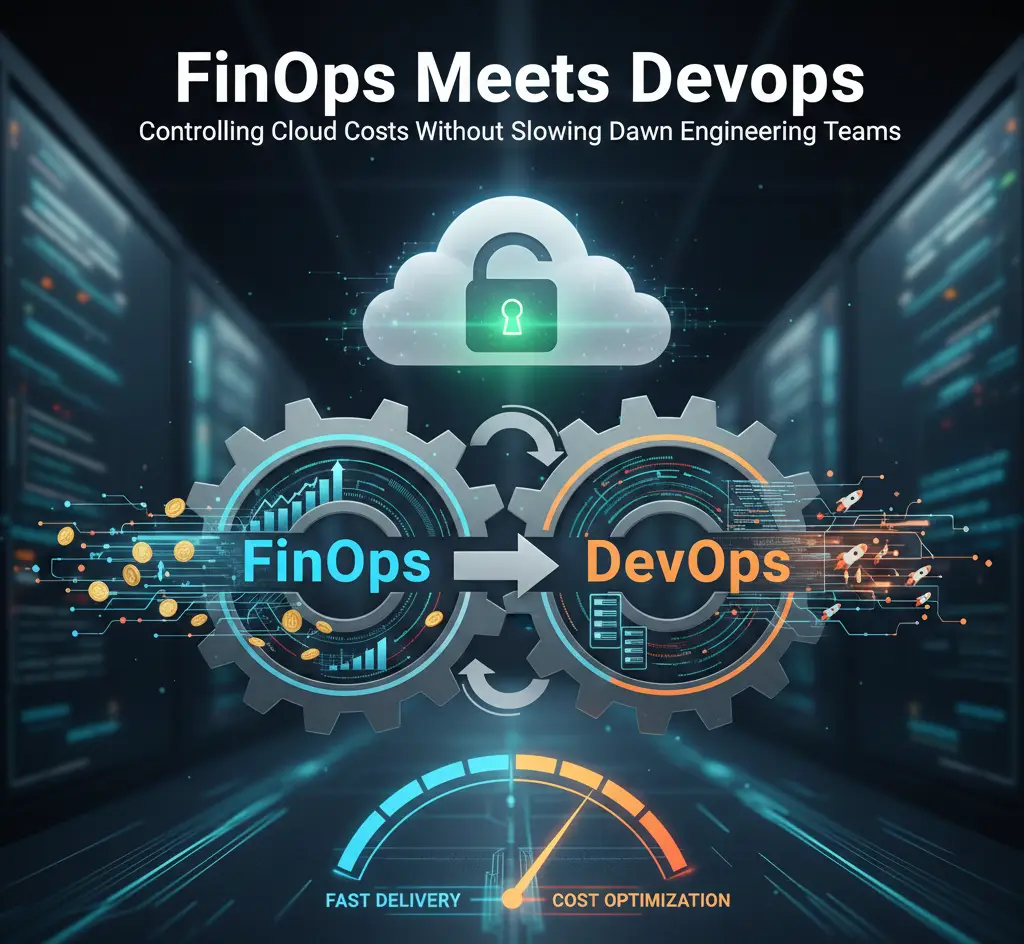
Initially, the use of cloud computing allowed different teams to execute tasks more quickly, to scale their operations more feasibly and to bring new ideas to the market without being held back by the lack of infrastructure. Nevertheless, with the increase in the amount of usage, the spending on cloud often tends to get out of hand. It is common for many organisations to realise that their bills keep getting higher, but there is no one who owns or is responsible for them. Hence, this has been the reason why the FinOps DevOps combination in 2026 is becoming a must for companies that want to grow in a sustainable manner.
In any case, today’s teams must manage budgets effectively without slowing engineering velocity.
The Cloud Cost Problem
The cost of cloud services is based on the amount of resources consumed. Although this kind of pricing gives the users more freedom, it can also be used as a cover for inefficiencies. The fact is that the teams can create the resources instantly, and then they just forget to get rid of them. It is the cases of unused environments, over-allocated services, and poorly designed architectures that are draining the budgets quite silently.
Without having proper access to the details, it becomes impossible for the leaders to visualise the flow of money. Engineers focus on developing features, while the finance team focuses on managing the budget. The lack of communication that results from this situation causes disagreement and leads to the postponement of decisions.
FinOps is the issue of getting these three different parties – Finance, Engineering and Operations – together on the topic of cost management.
What FinOps Really Means
FinOps goes well beyond a simple exercise in cutting down expenses. It represents a cultural and operational change that enables teams to handle their cloud costs in a collaborative way.
Within the FinOps culture, there is an emphasis on:
- The transparency of costs
- Teams share accountability across stakeholders
- Teams make decisions in real time
- Teams treat optimisation as an ongoing investment
Thanks to FinOps and DevOps collaboration in 2026, cloud expenses become a variable that teams can control and optimise, rather than a fixed cost that they have to tolerate.
Why DevOps Teams Struggle with Cloud Costs
The main features that a DevOps team looks for in their work are speed, reliability and automation. Cloud platforms provide them with the tools that make these aims attainable; however, they make the issue of pricing even more complicated.
The following are some of the typical problems that DevOps teams have:
- They are unable to tell how much each service or team is costing.
- Shared cloud resources are not owned by anyone.
- Cost reviews that are done manually arrive too late to be acted upon.
- Cost controls are implemented in such a fashion that they interfere with the speed of delivery.
In order to lower the cloud costs by using DevOps, the teams are required to integrate the awareness of costs into the engineering workflows.
Embedding FinOps into CI/CD Pipelines
The most successful approach to curbing cloud expenditure is to move FinOps to the left and, by doing so, to integrate it into the CI/CD pipelines.
Thanks to FinOps automation embedded in the CI/CD environment, the team is able to:
- Decision-makers get cost estimates prior to deployment.
- Resources that are over-budget get automatically blocked.
- Budget thresholds are enforced as code.
- Resource configurations are optimised during builds.
By integrating financial controls into DevOps pipelines, the team is capable of identifying cost risks at an early stage and thus, avoiding costly surprises upon release.
Cost Visibility and Accountability Models
When visibility is high, accountability is natural. By being able to clearly see how their decisions make an impact on the cloud costs, team members change their behaviour in a very organic way.
Here are some of the most efficient methodologies:
- Cost allocation by team, service, or environment
- Budget ownership at the product level
- Real-time cost dashboards for engineers
- Chargeback or showback models
Such methods are compatible with cloud cost optimisation in DevOps and do not require additional manual approvals or hamper the pace of delivery.
Automation for Cost Control
Automation has become a key element of contemporary FinOps strategies. Manual reviews cannot keep up with the rapid changes and complexities of the cloud environment.
With the help of automation, teams can:
- Teams scale services based on current demand
- Automation shuts down idle resources without human intervention
- Teams apply cost policies using Policy-as-Code
- Systems detect and correct waste proactively
Thanks to this automation, the teams can focus on maintaining their speed while also keeping a tight grip on their costs.
FinOps Tooling and Dashboards
With the assistance of modern FinOps tools, an organisation can monitor its cloud expenditure in real-time. These tools are capable of connecting not only with cloud providers but also with CI/CD systems, which results in seamless integration.
A potent toolset should provide:
- Forecasting and anomaly detection
- Cost allocation and reporting
- Budget alerts and recommendations
- Integration with deployment workflows
Cost data turns out to be actionable instead of merely informational when the teams are equipped with the right tools.
The Future of Cost-Aware DevOps
Certainly, by 2026, understanding of cost will be a built-in capability in DevOps teams. Thus, when engineers think about cost, they will be considering it just like they consider performance and security.
That kind of attitude results in:
- Teams make decisions faster and with fewer compromises.
- The cloud is growing in the way that is sustainable
- Finance and engineering are working in strong alignment
Cost-aware DevOps constitutes a positive force, empowering teams to innovate responsibly and continuously.
FAQs: FinOps and DevOps Integration
1. What is FinOps DevOps integration?
It aligns finance, engineering, and operations to collaboratively manage cloud costs without slowing down development.
2. How does FinOps automation in CI/CD help?
Enforcing cost controls early, it helps to reduce costs by estimating and validating them during the build and deployment stages.
3. Can teams reduce cloud costs using DevOps practices?
Absolutely. The trio of automation, visibility, and accountability facilitates continuous cloud cost optimisation in DevOps.
4. Does cost governance slow down engineering teams?
No. When carried out via automation and policy-as-code, it increases productivity without adding friction.
5. Who owns cloud costs in a FinOps model?
Ownership is not concentrated in a single person. The teams are accountable for the decisions, while the finance department offers governance and insight.